
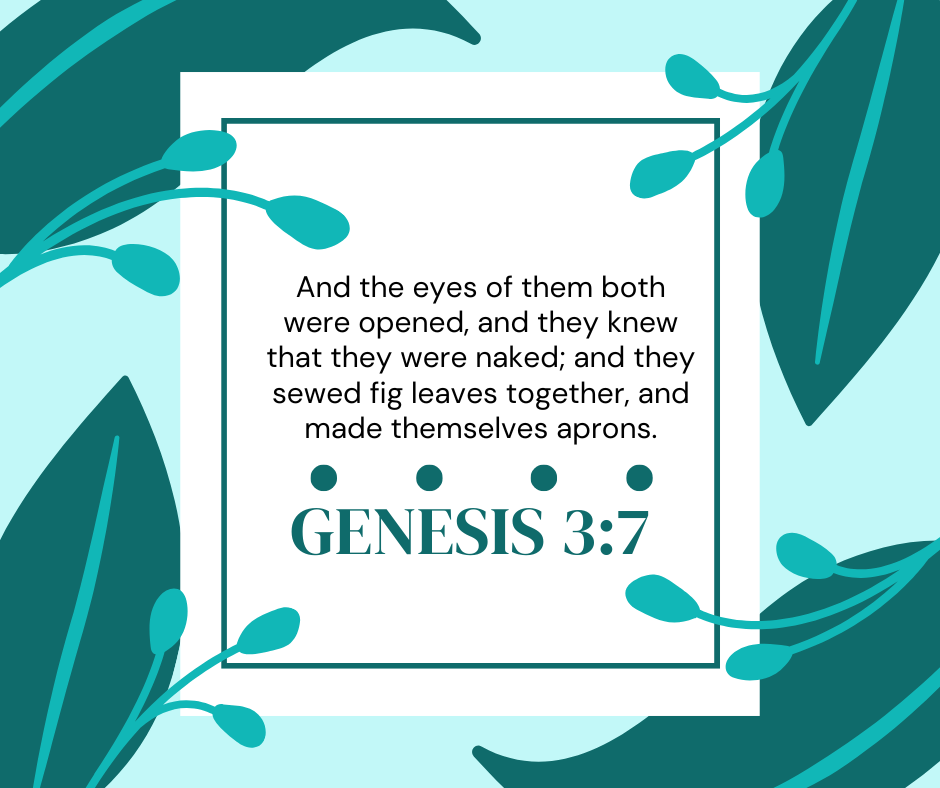
When we move beyond the ancient Near East into the broader landscape of world religions, we find that the themes embedded in Genesis 3:7—knowledge, shame, loss, and the longing for restoration—echo far beyond the borders of Israel. Nearly every major faith recognizes something has gone wrong with humanity, yet their explanations of why and how differ profoundly. Genesis 3:7 gives us a distinctly moral and personal account: sin awakens guilt and drives mankind to self-made coverings that can never suffice. Other religions preserve fragments of this truth, but all stop short of the full picture: the personal rupture between Creator and creature that only divine grace can mend.
I. Hinduism: Ignorance Without Guilt
Hindu cosmology also speaks of a primordial loss, though not through moral rebellion as in the Judeo-Christian account of the Fall. In Hindu thought—especially within Advaita Vedānta—the human predicament is avidyā, or ignorance of the true self. This ignorance leads individuals to misidentify themselves with the transient body and mind, rather than realizing their essential unity with Brahman, the ultimate reality. The resulting sense of separation is not rooted in guilt for moral transgression but in māyā, illusion, the mistaken perception of duality where none truly exists. Liberation comes not through moral restitution but through enlightenment: the dawning of true knowledge that one’s self is identical with Brahman. While Hindu traditions recognize moral consequence (karma) as part of human bondage, the underlying cause of that bondage is ontological ignorance rather than moral rebellion.1,2 In that framework, the “eyes opening” of Genesis 3:7 might even appear as progress—awakening from innocence to knowledge—an idea more Gnostic than biblical.
Hinduism redefines the problem Genesis identifies. The Bible describes alienation from a holy personal God; Hinduism describes ignorance of an impersonal divine essence. The attempt to “cover” oneself through ritual, asceticism, or good karma mirrors Adam and Eve’s fig leaves: sincere but self-sufficient acts seeking release without repentance. The Gospel alone confronts sin not as illusion but as rebellion and offers reconciliation, not absorption.
II. Buddhism: Suffering Without Sin
Buddhism shares with Genesis 3:7 a deep recognition of human suffering and shame, yet it denies any divine cause or personal guilt. The problem is not moral fallenness but craving , and the goal is not forgiveness but detachment.3,4 The “opened eyes” of enlightenment in Buddhism lead away from desire; in Genesis, the opening leads to shame because desire has been misdirected. The fig leaves of Genesis, in Buddhist analogy, might represent attachment itself: attempts to preserve the illusion of self and possession.
Buddhism’s analysis of human misery is psychologically insightful but theologically incomplete. It recognizes suffering but not sin, detachment but not deliverance. In Genesis, the problem is not desire itself but desire ungoverned by obedience. True peace comes not from extinguishing the self but from restoration through the God who covers and redeems it. The Gospel does not call humanity to escape awareness but to be reconciled through the one who bore our shame (Hebrews 12:2).
III. Taoism and Confucianism: Disharmony Without Transgression
Chinese philosophical traditions also echo elements of Genesis 3:7 but interpret them through the lens of cosmic order rather than covenant. In Taoism, humanity’s problem is disharmony with the Tao, the way of nature. Shame results from imbalance, not sin. The “covering” therefore becomes the restoration of harmony through simplicity and non-striving.5,6 Similarly, Confucianism interprets shame as moral imperfection within human relationships, not as rebellion against a Creator. The remedy is self-cultivation and virtuous example, not divine redemption.7,8
Genesis 3:7 identifies shame not as imbalance but as exposure before a personal God. Harmony can never be restored by aligning with impersonal order, because the rupture is relational. The first covering failed because the break was moral, not natural. Humanity’s fig leaves can hide from one another, but not from the divine gaze. Only a God who acts can restore what sin has undone.
IV. The Longing for Covering and the Uniqueness of Grace
Across the world’s religions, the echoes of Genesis 3:7 resound with haunting familiarity. Humanity senses that something is wrong: that knowledge has turned into burden, that innocence has been lost, and that shame demands concealment. Yet every religious system, apart from biblical faith, answers that awareness with a form of self-covering: ritual, morality, meditation, law, or discipline. Each system acknowledges the wound but prescribes self-made healing. Only Scripture insists that God Himself must act and that the covering must come from Him.
Genesis 3:7, therefore, stands as both a mirror and a measuring rod for all world religions. It shows that man’s instinct to cover is universal, but his coverings always fail. The fig leaves of Adam and Eve stretch across history, from temples to philosophies, from sacrifices to meditations. Yet none can erase the conscience that cries, “I am naked.” The Christian gospel alone answers that cry with divine initiative: “Unto Adam also and to his wife did the LORD God make coats of skins, and clothed them” (Genesis 3:21). All other religions begin with man reaching upward; the gospel begins with God stooping down.
Thus, when compared with the world’s faiths, Genesis 3:7 shines all the brighter, not as one myth among many, but as the true origin of the world’s longing for redemption. It reveals what every religion senses but none can solve: that sin leaves us exposed, and only grace can cover us.
- Sangeetha Menon, “Advaita Vedānta,” Internet Encyclopedia of Philosophy, accessed November 2, 2025, https://iep.utm.edu/advaita-vedanta/. ↩︎
- Dennis Waite, “Ignorance—not so Obvious!,” Advaita Vision, accessed November 2, 2025, https://www.advaita-vision.org/ignorance-not-so-obvious/. ↩︎
- Peter Harvey, An Introduction to Buddhism: Teachings, History and Practices, 2nd ed. (Cambridge: Cambridge University Press, 2013), 57–60, https://ia801801.us.archive.org/5/items/20200930_20200930_1742/An%20Introduction%20to%20Buddhism%2C%20Second%20Edition%20by%20Peter%20Harvey%20%28البوذية%29.pdf. ↩︎
- Nguyen Thi Quyet, Pham Thi Lan, and Nguyen Thi Phuong, “The Four Noble Truths: An Integrative Buddhist Philosophy of Life,” European Journal of Science and Theology 18, no. 6 (2022): 47–63, https://www.ejst.tuiasi.ro/Files/97/5_Quyet%20et%20al.pdf. ↩︎
- Lao Tzu, Tao Te Ching, chap. 12, accessed November 2, 2025, https://www.yellowbridge.com/onlinelit/daodejing12.php. ↩︎
- Ghorban Elmi and Mojtaba Zarvani, “Problem of Evil in Taoism,” The Journal of Religious Inquiries 5, no. 10 (2016): 35-47, accessed November 2, 2025, https://www.academia.edu/36790239/Problem_of_Evil_in_Taoism. ↩︎
- Mark Berkson, “A Confucian Defense of Shame: Morality, Self-Cultivation, and the Dangers of Shamelessness” Religions 12, no. 1 (2021): 32, https://doi.org/10.3390/rel12010032. ↩︎
- Fahrur Rozi, “The Confucian Concept of Self-Cultivation and Social Harmony,” International Journal of Language and Linguistics 7, no. 2 (June 2020): PDF file, https://ijllnet.com/journals/Vol_7_No_2_June_2020/15.pdf. ↩︎