
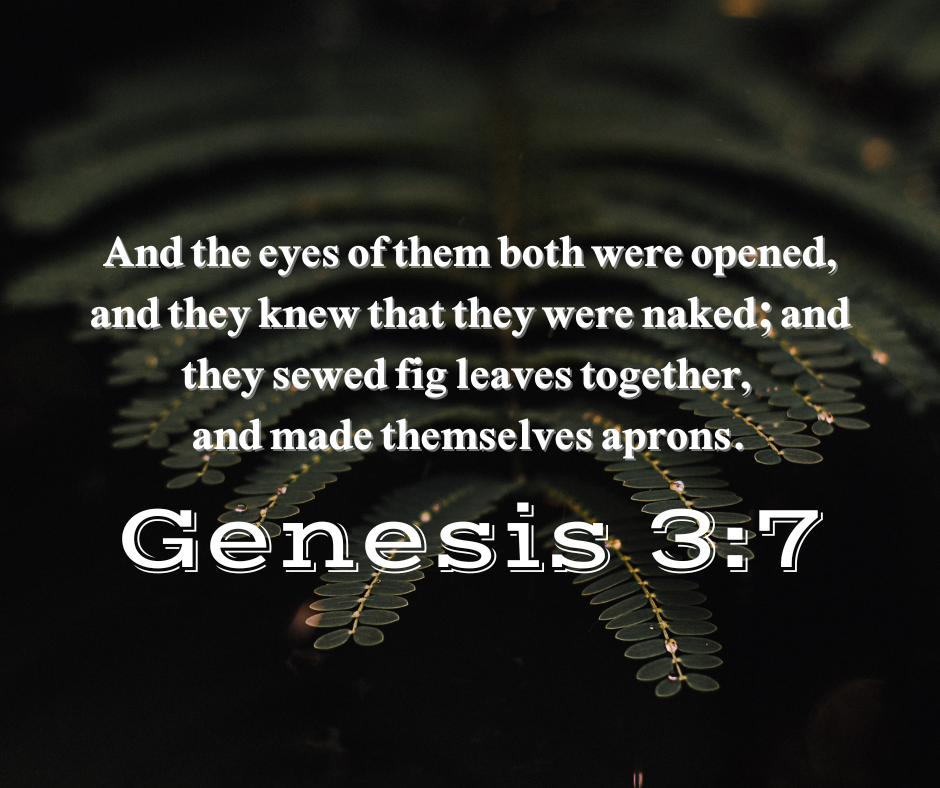
Kenneth A. Mathews observes that the consequences of Adam and Eve’s disobedience unfold with the same rapid momentum as their sin itself: eyes opened, nakedness realized, leaves sewn, and coverings made. The symmetry between the act and its aftermath highlights an essential truth: sin always moves quickly, but its effects linger long. What seemed so small—one bite, one moment of curiosity—triggered an avalanche of consequences that would shape the human soul forever. Mathews notes that what was once “pleasing to the eye” now becomes unbearable to behold; the very faculty that enticed them toward sin now mirrors back their corruption. Their supposed “wisdom” produces not godlike mastery but the shameful awareness of failure and loss. Humanity’s first enlightenment proves to be its first exposure.1
“And the eyes of them both were opened”
This phrase introduces not illumination but devastation. The Hebrew verb pāqaḥ (“to open”) can describe sudden perception—as when Elisha’s servant saw the unseen chariots of God—but here, it describes perception corrupted by sin. The serpent’s promise of enlightenment finds its cruel fulfillment: their eyes are opened, but their hearts are darkened. What was meant to grant freedom delivers captivity. As Robert Bergen notes, the knowledge they gained “brought only a sense of human inadequacy, fear, and shame.”2 The moment they ate, a great reversal took place. They saw the world and themselves through a lens of loss. Innocence vanished, and the first experience of “knowing” was the anguish of realizing what could never be undone.
This awakening marks the death of spiritual simplicity. Their gaze turns inward for the first time, and in that inwardness lies the essence of sin: self-consciousness severed from God-consciousness. Before the fall, their eyes beheld creation as an unbroken reflection of divine goodness. Now, they behold themselves and find distortion. Sin did not expand their sight; it fractured it. What the serpent called “knowing good and evil” is not wisdom gained but purity lost.
“And they knew that they were naked”
With this realization comes the first human experience of shame. In Genesis 2:25, Adam and Eve’s nakedness symbolized transparency, innocence, and perfect harmony between body and soul. The deliberate wordplay between ‘ārummîm (“naked”) in 2:25 and ‘ārûm (“crafty”) in 3:1 is striking. The same openness that once reflected divine simplicity now reflects moral cunning. The knowledge they sought has inverted creation’s order. Nakedness, once the emblem of freedom, becomes the emblem of exposure.
Henry Morris insightfully connects this recognition not only to Adam and Eve’s personal guilt but to the awareness of a generational consequence: that sin and death would now pass through them to all their descendants.3 In that instant, Adam, as the covenantal head of humanity, perceives the far-reaching shadow of his act. The divine blessing of fruitfulness will henceforth carry the burden of sin’s inheritance, a truth Paul later captures in the words, “Through the offence of one many be dead” (Romans 5:15).
Theologically, this verse reveals the deep rupture between the material and the spiritual. Humanity, created as a unified whole, now experiences disintegration. The body, once an unashamed expression of the soul, becomes a reminder of vulnerability. The soul, once at peace before God, now recoils in guilt. This is the birth of alienation from God, from one another, and even from oneself.
“And they sewed fig leaves together”
What follows is as tragic as it is revealing. The first human instinct after sin is not repentance but self-repair. They “sewed fig leaves together, and made themselves aprons.” In that single act, we see the birth of human religion: the attempt to cover guilt through human effort. The fig leaf, large but fragile, represents a temporary, inadequate response to a permanent problem. The Hebrew ḥăgōrōt (“coverings around the waist”) suggests hurried, minimal concealment. They cover what they cannot cleanse.
H. L. Willmington calls this the first “man-made religion,” and rightly so.4 Ever since that day, people have been sewing new kinds of fig leaves: good works, morality, ritual, and self-justification. Every human system of salvation apart from divine grace traces its roots back to this moment. The leaves symbolize our frantic attempts to hide from the truth that only God can make us whole.
Yet not all interpreters see this act purely as rebellion. Irenaeus, in a more charitable light, regarded Adam’s sewing of fig leaves as an early sign of repentance, an acknowledgment of wrongdoing and a humble effort to show remorse. He suggested that the roughness of the leaves symbolized Adam’s willingness to accept discomfort as a token of contrition. However, this reading falters theologically. Repentance, in Scripture, does not consist in self-punishment or symbolic effort but in turning back to God in dependence. Adam and Eve’s instinct to cover themselves is natural, but it still moves in the wrong direction: away from grace, not toward it. Their effort is a substitute for repentance, not an expression of it. Only God’s later act of clothing them with animal skins (Genesis 3:21) points to the true nature of repentance: acknowledging helplessness and receiving divine provision.
The Serpent’s Cruel Irony
In this verse, the serpent’s deceit reaches its climax. His words—“your eyes shall be opened”—prove partially true but fatally twisted. Humanity does “know” good and evil, but not as God knows them. The knowledge they gain is experiential, not intellectual. Evil is no longer an idea but a condition. Augustine’s comment captures the irony perfectly: “Their eyes were opened not to gain light, but to lose it.”5 They learn about evil the way a person learns about drowning: by sinking into it.
This is the cruelest aspect of the fall. The serpent offers godhood but delivers guilt. He promises knowledge but gives corruption. The result is a half-truth with devastating consequences: awareness without innocence and conscience without peace. As John J. Davis explains, they now face the same dilemma Paul describes in Romans 7:19, knowing good but powerless to perform it, and knowing evil but unable to resist it.6 Humanity’s first “enlightenment” becomes its first bondage.
A Flicker of Hope
And yet, even in this darkness, God leaves a glimmer of grace. Their awareness of nakedness, though painful, proves that the image of God remains. Conscience is the echo of His voice still reverberating in the human heart. Shame, in this sense, becomes mercy’s first messenger. It signals that sin has not yet silenced the soul. The desire for covering, however misplaced, shows that humanity still senses the need for redemption.
That instinct, faint but real, points forward to the gospel. God will not destroy these newly fallen image-bearers; He will pursue them. The temporary fig leaves will give way to the permanent garment of sacrifice, foreshadowing the righteousness of Christ. What begins in self-made shame will end in divine grace. The eyes that were opened in judgment will one day be opened in joy when they behold the Lamb of God who takes away the sin of the world.
In Genesis 3:7, the Bible captures humanity’s first awareness of sin and the beginning of its redemption. It is the moment when vision turns inward and when shame enters history, but also when the faint outline of grace first appears. Sin’s first whisper is despair; God’s first response is mercy. The fig leaves will fall apart, but God’s covering will endure forever.
- Kenneth A. Mathews, Genesis 1–11:26, The New American Commentary 1A (Nashville: B&H Publishing Group, 1996), 239. ↩︎
- Robert D. Bergen, “Genesis,” in Everyday Study Bible (Nashville: Holman Bible Publishers, 2018), 13. ↩︎
- Henry M. Morris, The New Defender’s Study Bible (Nashville: World Publishing, 1995), 20. ↩︎
- H. L. Willmington, Willmington’s Guide to the Bible (Wheaton: Tyndale House Publishers, 1984), 6. ↩︎
- Thomas C. Oden, ed., Ancient Christian Commentary on Scripture, Old Testament, vol. 1 (Downers Grove: InterVarsity Press, 2001), 82. ↩︎
- John J. Davis, Paradise to Prison (Salem: Sheffield Publishing Company, 1975), 91. ↩︎