
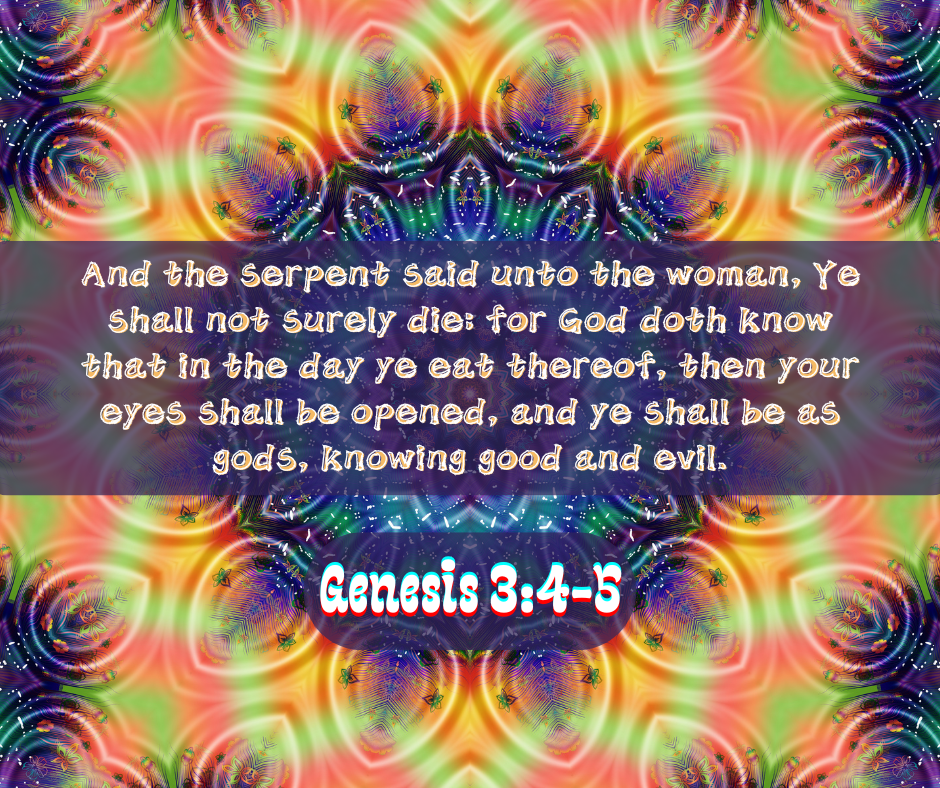
Few modern reinterpretations of Genesis 3:4–5 are as radically idealistic as those found in the metaphysical movements of the 19th and 20th centuries, especially Christian Science and the broader New Thought tradition. These movements emerged in the same cultural moment that gave rise to Transcendentalism, spiritual healing movements, and a reawakening of interest in the “power of mind.” Within this context, the serpent’s lie—“Ye shall not surely die”—came to be read not as deception but as a profound metaphysical truth. Death, sin, and matter themselves were reclassified as illusions of human consciousness. “Opened eyes” meant the awakening of spiritual perception, and “ye shall be as gods” implied the discovery of one’s own unity with Divine Mind. In this reading, the Fall becomes not the beginning of moral rebellion but the beginning of false belief, a mental error that obscures the perfect, spiritual reality of God and man.
Mary Baker Eddy, founder of Christian Science, systematized this idea in Science and Health with Key to the Scriptures (1875). For her, Genesis 3 does not describe a historical transgression but a symbolic dream, a parable of the human mind’s descent into material thinking. The serpent’s promise, she argued, contains a kernel of truth: humanity is indeed spiritual, deathless, and divine in nature, but it has “fallen asleep” to this truth by accepting the illusion of matter and mortality. In Eddy’s words, “death is but a mortal illusion, for to the real man and the real universe there is no death-process.”1 Thus, “Ye shall not surely die” becomes a metaphysical assertion: since man reflects the infinite Mind that is God, he cannot die in any real sense. Salvation, in this schema, is not redemption through Christ’s atoning death but realization, an awakening to the eternal spiritual truth that sin, sickness, and death never truly existed. Eddy’s reinterpretation of this passage thus mirrors Gnosticism’s old inversion: it recasts the serpent’s denial of judgment as spiritual enlightenment, though now in metaphysical rather than mythological terms.
The broader New Thought movement, which influenced Christian Science and later inspired movements like Unity, Religious Science, and even strands of prosperity teaching, follows a similar trajectory. It teaches that thought creates reality, and that aligning one’s consciousness with Divine Mind brings harmony, health, and abundance. Genesis 3:4–5, under this lens, becomes a parable of mental limitation: the serpent’s “Ye shall be as gods” is interpreted as humanity’s forgotten birthright to co-create with the divine. The tragedy of Eden is not that man reached too high but that he fell into ignorance of his spiritual nature. “Your eyes shall be opened” becomes an affirmation of spiritual awakening, the moment when man realizes he was never truly separated from God. This view turns the Fall into a dream from which humanity must awaken, not a rebellion for which it must repent.2
Yet this is precisely where biblical Christianity parts ways. The scriptural narrative grounds death not in illusion but in moral consequence: “in the day that thou eatest thereof thou shalt surely die” (Genesis 2:17). To deny the reality of sin and death is to unravel the gospel itself, for the cross of Christ assumes that both are real. Jesus does not merely correct our false perceptions; He bears sin in His own body on the tree (1 Peter 2:24). Salvation is not a reeducation of the mind but a recreation of the soul. Moreover, by collapsing the Creator–creature distinction, metaphysical systems exchange the personal God of Scripture for an impersonal principle of divine consciousness. This dissolves the moral universe into abstraction: evil becomes ignorance, not offense; grace becomes knowledge, not forgiveness. The result is a religion without repentance and a spirituality without the cross.
In this way, Christian Science and New Thought provide a modern echo of the serpent’s ancient promise: You will not die; you are divine; your eyes need only be opened to see it. The vocabulary is spiritual, even optimistic, but the theology is inverted. Where Scripture calls humanity to faith and humility, metaphysical idealism calls it to self-realization. Where the gospel heals by grace, metaphysical thought heals by affirmation. The serpent’s whisper is reframed as the soul’s awakening. But the Bible insists the opposite: true sight begins not with denial of death but with confession of it, and with the discovery that the God who warned of death has, through Christ, conquered it.
- Mary Baker Eddy, Science and Health with Key to the Scriptures (Boston: The Christian Science Publishing Society, 1910), 289:18, https://www.christianscience.com/the-christian-science-pastor/science-and-health/chapter-x-science-of-being?citation=SH%20289:14-289:20. ↩︎
- Liza J. Rankow, “Toward the Prophetic: A New Direction in the Practice of New Thought,” Religion Online, accessed October 10, 2025, https://www.religion-online.org/article/toward-the-prophetic-a-new-direction-in-the-practice-of-new-thought/. ↩︎