
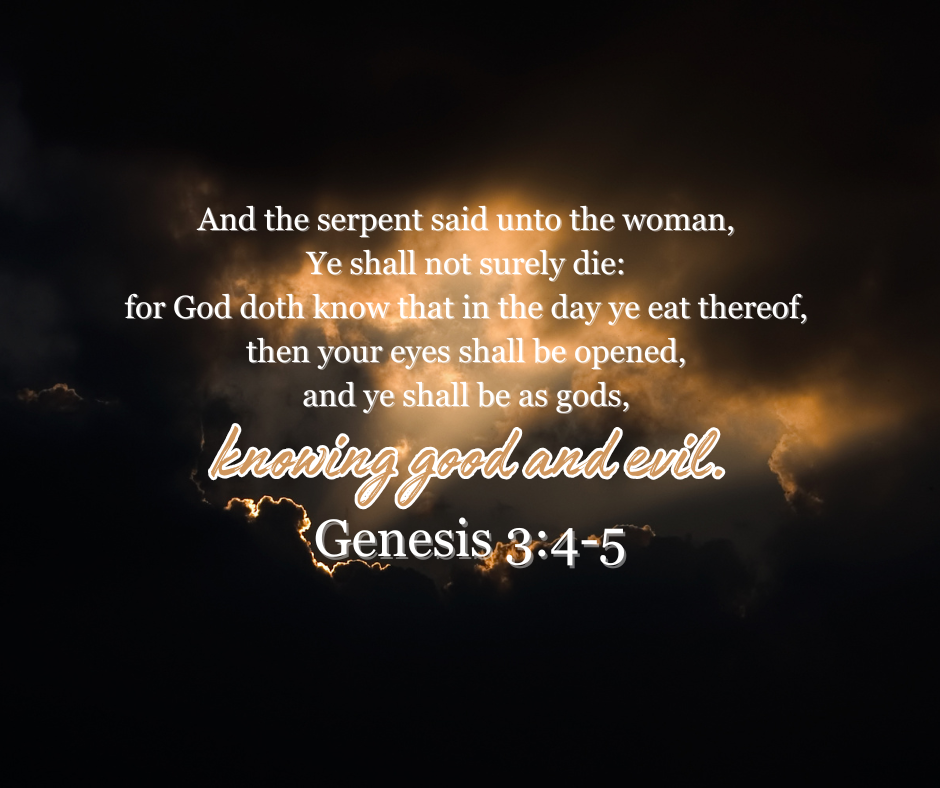
If “ye shall be as gods” is the summit of the serpent’s promise, “knowing good and evil” is the path he offers to get there. The phrase is not incidental; in Scripture it signals moral discernment and judicial authority: the capacity to render verdicts about right and wrong (cf. Deuteronomy 1:39; 1 Kings 3:9; Isaiah 7:15–16). In other words, the serpent is not merely dangling information but advertising autonomy: you can be the ones who decide. As Henry Morris puts it, “Satan’s deceptions are always most effective when they have some truth in them. Through eating the forbidden fruit, Adam and Eve would indeed come to ‘know good and evil,’ but not ‘as gods.’”1 The half-truth is the hook.
What, then, did they actually gain? Not God’s serene, sovereign knowledge, but the sinner’s burdened knowledge. David H. Sorenson captures the tragedy: before this moment, “neither Eve nor Adam knew anything about evil… After he had enticed them to sin, they did come to know the distinction between good and evil. However, it was from the sinner’s perspective and not that of an infinitely holy God.”2 Their “opened eyes” (Gen 3:7) perceive the jagged edge of evil from the inside—shame, fear, hiding—not the wise mastery of a holy Judge. They “know” now as the wounded know a blade, not as a surgeon knows an instrument. The promise delivers experience of evil, not dominion over it.
The Hebrew wording in Genesis 3:5—yod‘ei ṭov vara‘ (“knowing good and evil”)—also carries a kingly ring elsewhere in Scripture. Solomon asks for “an understanding heart… to discern between good and bad” (1 Kings 3:9). Children are described as those who “have no knowledge between good and evil” (Deuteronony 1:39). The serpent seizes this noble category of God-given discernment and twists it into a project of self-exaltation: seize the prerogative now, on your terms, apart from God’s instruction. The result is a dark parody of wisdom: discernment divorced from devotion.
John Walton has suggested that God may have intended, in time, to grant this knowledge properly, that the prohibition concerned timing rather than the thing itself (he compares it to driving being good, but not for a five-year-old; and to Satan offering Jesus rightful kingship by wrong means in Luke 4:5–7).3 It’s a thoughtful attempt to correlate biblical patterns of maturation with Eden’s test.
However, in Genesis 2:17 the Lord states, “of the tree of the knowledge of good and evil, thou shalt not eat of it… thou shalt surely die.” There is no hint of a future permission clause. By contrast, Genesis 3:22—“Behold, the man is become as one of us, to know good and evil”—reads the new “knowledge” as an achieved, fallen state, not as the delayed receipt of a promised gift.
Walton’s analogy helpfully underscores that means and timing matter to God, yet the text itself does not signal a future, legitimate eating of this tree. On balance, his proposal seems to step past what the passage says, turning a clear prohibition with a death-sanction into a delayed blessing. The safer, plainer reading is that the “knowledge” gained through sin was qualitatively different from godly discernment: it was the knowledge of guilt, not of God.
“Knowing good and evil,” then, is not the Bible’s pathway to godlikeness; it is the sinner’s self-appointment to the bench. The Creator intended His image-bearers to grow into wisdom with Him: to receive and reflect His judgments in trusting fellowship. The serpent proposed wisdom without Him: to render verdicts from the dock of a rebel heart. And that is the choice still before us: to seek sight by submission (“The fear of the LORD is the beginning of wisdom,” Proverbs 9:10) or to grasp at sight by sin, only to awaken, like our first parents, with eyes open and hearts heavy.