
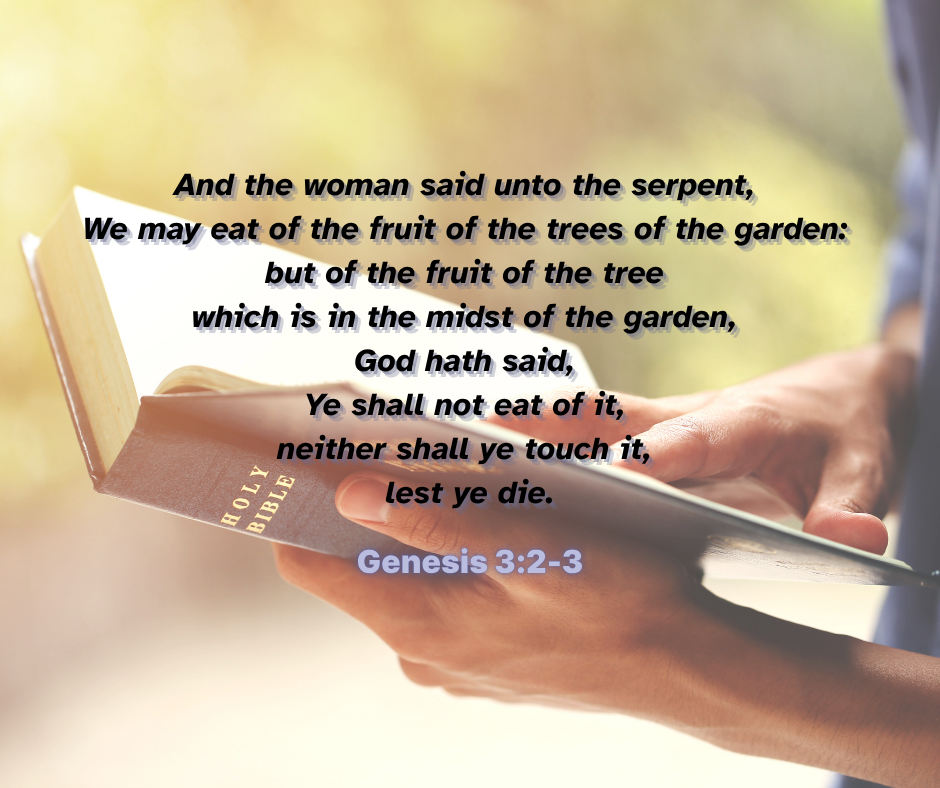
Having traced the doctrinal truths embedded in Eve’s restatement of God’s command, we can now ask a broader question: how was this passage received and understood beyond Eden itself? Genesis 3:2–3 may appear to be a small detail, just a few lines of dialogue, yet it has carried extraordinary weight in the history of interpretation. Early Jewish commentators and the church across its many branches have returned repeatedly to these verses, seeing in them the seeds of later debates about Scripture, sin, temptation, and the frailty of the human heart. What Eve said—and how she said it—has been read as a mirror for Israel’s struggles, a warning for the church, and a lens through which whole traditions of theology have been formed.
I. Judaism: The Classic Caution Against Adding to the Command
Since Genesis is first and foremost Israel’s Scripture, it is natural to begin with Jewish interpretation. Within Jewish tradition, Eve’s extra phrase—“neither shall ye touch it”—has often been read as a cautionary tale about the dangers of confusing human safeguards with divine command. The medieval commentator Rashi puts it memorably: Eve “added to God’s command… therefore she was led to diminish it.”1 His diagnosis is concise but penetrating. By creating an extra prohibition, Eve introduced a standard God Himself had not set.
This concern is not isolated to Rashi but resonates with the broader rabbinic tradition. The Mishnah famously encourages Israel to “make a fence around the Torah” (Pirkei Avot 1:1). The impulse is understandable: better to stay far from the line than risk crossing it. But Genesis 3:2–3 is often treated as an example of how those fences can go wrong when they are elevated to the same level as God’s own words. Deuteronomy 4:2 echoes in the background: “Ye shall not add unto the word which I command you, neither shall ye diminish ought from it.” The lesson is not that all protective boundaries are misguided, but that the moment human rules are treated as divine revelation, the door is opened to confusion and to temptation.
Later Jewish reflection often wrestled with this tension. Fences, rightly used, were seen as wise practices of holiness, guiding Israel toward obedience in daily life. But the story of Eve’s addition remained a sobering reminder: if those practices are ever mistaken for the command itself, they risk undermining the very Word they were meant to protect. In this way, Jewish interpretation highlights the fine line between reverence and distortion, between wise precaution and dangerous overreach. For Judaism, then, Genesis 3:2–3 is not just the prologue to the Fall; it is a mirror for Israel’s ongoing task: receiving the Torah with seriousness, guarding it with care, and ensuring that God’s voice remains distinct from human tradition.
Catholicism: Safeguard or Addition?
Catholic interpretation takes us in a different but related direction. Within Catholic theology, Genesis 3:2–3 is usually understood less as a commentary on Scripture itself and more as the first crack in humanity’s state of original holiness and justice. Eve’s slight distortion—her omission, her addition, her softening—signaled the beginning of humanity’s alienation from God’s gift of grace. For Catholic commentators, the lesson is pastoral: fear, misunderstanding, and mistrust clouded Eve’s perception of God’s generosity. By adding “neither shall ye touch it,” she revealed how human anxiety can reshape divine goodness into something narrower or more burdensome.
Yet Catholic theology does not stop there. It draws a further implication: the very danger Eve embodies—that God’s word could be distorted by faulty memory or human improvisation—underscores the need for a trustworthy guardian of revelation. In Catholic thought, that role is filled by the Magisterium, the church’s teaching office. Together with Scripture, apostolic Tradition forms what the Catechism calls a “single sacred deposit of the Word of God.” The two, Catholics argue, must be “accepted and honoured with equal sentiments of devotion and reverence.”2 From this perspective, where Eve improvised and faltered, the Church is charged with faithfully preserving, interpreting, and transmitting revelation without subtraction or inflation. The Magisterium is seen not as adding to Scripture but as protecting it from the very distortions that led to the Fall.
Of course, this is where Catholic interpretation reveals a striking irony. By elevating Tradition alongside Scripture, the Catholic Church claims to safeguard revelation against distortion. Yet in doing so, it effectively supplements Scripture with an authority God never commanded, the very danger the text itself warns against. Eve’s addition, “neither shall ye touch it,” was no act of rebellion; it was an attempt at protection. But that well-intentioned hedge became the opening for deception. In the same way, the Catholic attempt to preserve Scripture through Tradition risks adding to God’s Word under the guise of guarding it. The lesson of Genesis 3:2–3 is that God’s Word is most secure when it is received and held precisely as given, without addition, subtraction, or alteration.
Eastern Orthodoxy: Watchfulness, Communion, and the Drift Toward Corruption
In the Eastern Orthodox tradition, Eve’s words in Genesis 3:2–3 are often read less as a commentary on law or Scripture, and more as a window into humanity’s loss of communion with God. Orthodoxy frames the Fall not primarily in terms of guilt inherited from Adam and Eve, but in terms of ancestral corruption: the introduction of mortality, disordered desire, and broken fellowship with God. In that light, Eve’s reply is seen as the first fracture in the life-giving union between God and His creatures. By restating His command imprecisely, she reveals a heart already drifting from the fullness of divine communion. What had been spoken in life and covenant is reshaped as something less certain, less generous, less relational. Orthodoxy sees here the earliest sign of humanity slipping toward corruption, a distortion that blossoms into the Fall.
This interpretation also draws heavily on the Orthodox emphasis on nepsis, or watchfulness. The fathers often urged believers to guard the heart and the mind with vigilance, for lapses in attention open the door to deception. Eve’s words, “neither shall ye touch it… lest ye die,” embody such a lapse. Rather than holding fast to the precise word of God, she allowed her recollection to be colored by fear, caution, and softening. In Orthodox reflection, this is not so much rebellion as failure in spiritual watchfulness. The serpent exploited that weakness, and communion was lost. Thus Genesis 3:2–3 becomes a paradigm: the human heart, failing to keep careful watch over the Word, loses the clarity needed to resist the adversary. The lesson is clear: only continual prayer, vigilance, and immersion in divine truth can keep the soul safe from distortion.3,4,5
Yet here we must note a divergence from the plain reading of the text. Scripture itself presents God’s command as law—clear, binding, and authoritative—and Eve’s restatement as a distortion of that law. Orthodoxy, however, tends to interpret the passage more mystically, as primarily about communion and corruption rather than about revelation and disobedience. While this emphasis on relationship is not without merit, it can underplay the seriousness of Eve’s verbal alteration of God’s command. The plain reading of Genesis 2:16–17 and 3:2–3 shows that words matter, and that the Fall begins with a distortion of divine speech. By prioritizing categories of mortality and communion over the covenantal authority of God’s command, Eastern Orthodoxy shifts the weight of the passage. Still, their focus on nepsis does provide a practical takeaway: Eve’s lapse warns the faithful to guard the Word in their hearts with vigilance, lest distortion again pave the way for disobedience.
Lutheran and Reformed Traditions: The Word Alone Preserved in Its Purity
Within the Lutheran and Reformed traditions, Genesis 3:2–3 has often been treated as a vivid warning about the danger of failing to preserve God’s Word in its purity. Eve’s subtle edits illustrate how quickly divine truth can be compromised when not held fast in faith. What may appear to be a harmless paraphrase is, in reality, the seedbed of unbelief. For these traditions, the passage demonstrates how the serpent works: not first by outright denial, but by exploiting small shifts in God’s Word. The lesson is clear: Scripture must remain the sole and unshakable authority for faith and life, because even the slightest distortion of revelation weakens the believer’s defense against deception.
This conviction lies at the heart of sola Scriptura, the Reformation principle that Scripture alone is the ultimate rule of faith, sufficient and authoritative in itself. Eve’s misquotation became a paradigm of what happens when God’s Word is diluted, supplemented, or treated as negotiable. In the Reformers’ teaching, the church must resist the temptation to add human rules or traditions as though they were divine law and equally resist the impulse to soften or downplay God’s warnings. For them, Genesis 3:2–3 was not merely an ancient story but a perpetual reminder: the adversary always begins by questioning the Word, and believers must answer with the unaltered truth. Just as Jesus countered Satan in the wilderness with precise citations from Deuteronomy, so the church is called to wield Scripture faithfully, without omission or addition.
When set alongside the plain reading of Genesis, the Lutheran and Reformed approach proves to be both careful and faithful. Their interpretation is not an overreach but a faithful amplification of what the text itself shows: Eve’s words were altered, and those alterations made room for deception. Where some traditions lean toward mystical communion or ecclesial authority, the Reformers pressed the simple point that God’s Word must be preserved as given.
Arminian and Wesleyan Traditions: Responsibility in the Face of Temptation
Where others underscore the danger of Eve’s distorted words, Arminian and Wesleyan traditions are more likely to see her reply as a vivid illustration of human responsibility. For them, the heart of the passage lies not only in what was said, but in the fact that Eve, as a free moral agent, chose how to respond. Her decision to reframe God’s command is an act of will, showing that sin is not inevitable but arises through voluntary choices in the moment of testing. Genesis 3:2–3 thus becomes a paradigm of how human beings, created with freedom, are accountable for what they do with God’s Word.
This reading fits well with the Wesleyan doctrine of prevenient grace, the teaching that God enables every person, through His grace, to respond to His Word in obedience or disobedience. In Eve’s case, that grace was fully present: she stood unfallen, able to obey without the weight of inherited corruption. Her imprecise reply is therefore not dismissed as a trivial slip but interpreted as a genuine choice that opened the door for deception. Wesleyan preaching has often used this scene pastorally: just as Eve’s words show how lightly handling God’s command can lead to ruin, so believers today are reminded to guard their hearts, exercise vigilance, and lean on God’s enabling grace to choose rightly. In this way, Genesis 3:2–3 becomes a call to take responsibility for the words we believe, repeat, and act upon.
When compared with the plain reading of Genesis, the Arminian/Wesleyan approach has much to commend it. The text does indeed highlight Eve’s active role in reshaping God’s command, and her accountability is front and center. Yet one possible weakness in this emphasis is the tendency to frame the episode primarily as a drama of choice, rather than first and foremost as a distortion of divine revelation. The plain sense of Genesis emphasizes what God said and how Eve altered it; the question of free will is implied but not foregrounded. Still, the Arminian and Wesleyan reading captures an important truth: Eve was not a puppet of fate or an innocent bystander. She was a responsible moral agent, and her words remind us that how we handle God’s truth is always a matter of will as well as memory.
Modern Evangelical and Free Church Traditions: Precision with Pastoral Urgency
When we turn to modern Evangelical and Free Church traditions, Genesis 3:2–3 is often read through a blended lens. On the one hand, these traditions inherit from the Reformation a deep concern for the purity of God’s Word. Eve’s omissions and additions are treated as a sober warning: Scripture must be preserved without distortion, because every deviation creates an opening for error. On the other hand, Evangelical preaching frequently echoes Wesleyan emphases, stressing human responsibility and the call to vigilance. Eve’s altered reply is not only an exegetical problem but a pastoral one: she chose to handle God’s command carelessly, and that choice set in motion disastrous consequences.
In this sense, Evangelical interpretation typically stresses both precision and urgency. The Reformed instinct insists that God’s Word must be handled with care, repeated with accuracy, and defended against dilution. The Wesleyan instinct reminds believers that carelessness with God’s Word is not an abstract doctrinal danger but a lived spiritual risk. Sermons and Bible studies in Evangelical contexts often draw out both threads. On the one hand, Eve’s words serve as an object lesson in hermeneutics: we must not add to or subtract from God’s revelation. On the other hand, they serve as an exhortation to daily discipleship: careless paraphrases, softened warnings, and ungrateful hearts still leave us vulnerable to the serpent’s lies.
Against the plain reading of Genesis, this synthesis is faithful. The text itself emphasizes the distortion of God’s Word, which resonates with Evangelical calls for doctrinal precision. At the same time, Eve’s active role in reshaping the command highlights her moral responsibility, aligning with Evangelical applications that stress vigilance and obedience in the Christian life. If there is a limitation, it may be that this blended reading can sometimes collapse into moralism, a warning against carelessness without always tracing the narrative forward to Christ, the Second Adam who perfectly upheld God’s Word. But at its best, the Evangelical/Free Church approach preserves the integrity of Scripture while pressing home the personal urgency of obedience. Genesis 3:2–3, then, becomes both a hermeneutical anchor and a pastoral exhortation: God’s Word must be held exactly as given, and believers must be watchful to live in faithful response to it.
Threads Woven Together
When we step back and look at the range of interpretations, a fascinating mosaic emerges. Jewish commentary reads Eve’s addition as the classic warning against confusing human fences with divine command. Catholic theology emphasizes how her distortion marks the first crack in humanity’s original holiness, highlighting the Magisterium’s role as a safeguard, but in doing so, risks adding the very layers the text itself warns against. Eastern Orthodoxy frames Eve’s lapse in terms of lost communion and the need for spiritual watchfulness (nepsis), though sometimes at the expense of the plain legal weight of God’s command. The Reformed and Lutheran traditions place the spotlight on the purity of God’s Word, insisting that even the smallest distortion must be resisted. The Arminian and Wesleyan families stress human freedom and responsibility, treating Eve’s reply as a choice that illustrates the power of the will to obey or disobey. And modern Evangelical and Free Church voices often blend these concerns, holding tightly to the precision of the Word while pressing home the pastoral urgency of obedience.
Taken together, these perspectives remind us that Genesis 3:2–3 is no incidental detail. It is a prism refracting the light of Scripture into questions of authority, grace, freedom, communion, responsibility, and vigilance. While traditions emphasize different aspects, they all recognize that Eve’s altered words carry weight far beyond the garden. At stake here is not only the truth of what God said, but the way His Word is received, remembered, and retold by His people.
In the end, they all agree that something significant happened when Eve reshaped God’s command. The debate is about what lesson to draw: is it primarily about adding to the law, safeguarding revelation, guarding communion, preserving purity, exercising responsibility, or applying vigilance? The truth is that Genesis 3:2–3 contains elements of all these concerns. It warns us about distortion, calls us to responsibility, and shows us our desperate need for the One who would come and keep God’s Word perfectly.
- Rashi, Commentary on Genesis, on Gen 3:3.1–4:1, in Sefaria, https://www.sefaria.org/Rashi_on_Genesis.3.3.1‑4.1 (accessed October 3, 2025). ↩︎
- Catechism of the Catholic Church, § 82, Vatican website, https://www.vatican.va/archive/ENG0015/__P2.HTM#‑82 (accessed October 3, 2025). ↩︎
- Nikophoros the Monk, On Watchfulness and the Guarding of the Heart, in Philokalia, https://orthodoxchurchfathers.com/fathers/philokalia/nikiphoros-the-monk-on-watchfulness-and-the-guarding-of-the-heart.html, (October 3, 2025). ↩︎
- John S. Romanides, The Ancestral Sin, (Zephyr, 2002), https://archive.org/details/ancestralsin0000roma/mode/2up, (October 3, 2025). ↩︎
- “Doctrine & Scripture: Sin,” Orthodox Church in America, OCA.org, https://www.oca.org/orthodoxy/the-orthodox-faith/doctrine-scripture/the-symbol-of-faith/sin, (October 3, 2025). ↩︎