
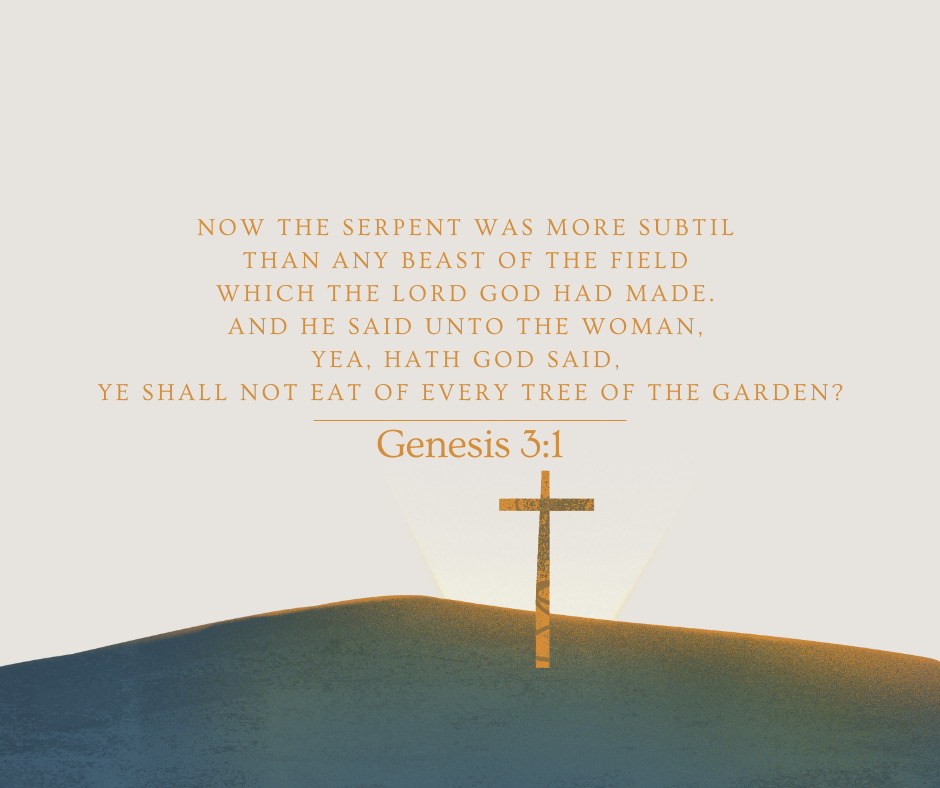
Genesis 3:1 does more than recount the first temptation; it speaks directly to the life of the church and to every believer today. The serpent’s whisper was not silenced in Eden. It continues to echo in subtle doubts, cultural voices, and the quiet struggles of the heart. For those in Christ, the verse presses us toward faithfulness: to hold fast to God’s Word, to resist distortion, and to walk together in trust. For those not yet in Christ, the verse lays bare the universal human condition: we have all doubted God’s truth and turned from His goodness. Yet into that brokenness comes the good news: the Word made flesh, who silences the lie and restores us to God.
I. Living Amid the Whisper
The serpent’s first tactic in Genesis 3:1 was not a violent strike or an obvious denial but a whispering question: “Yea, hath God said?” That question continues to echo in every believer’s life. It comes in quiet moments when God’s promises feel too good to be true, when His commands feel heavy, or when cultural voices mock His Word as outdated. We may not face the serpent in Eden, but we hear his question whenever doubt presses in: Did God really mean what He said?
For the church corporately, Genesis 3:1 is a reminder that deception rarely begins with a frontal assault. It begins with the erosion of confidence in God’s Word. For the believer personally, it is a call to vigilance. Each of us is tempted at times to reinterpret God’s truth to suit our desires, to minimize His generosity by magnifying His restrictions, or to exchange His clear voice for the fog of speculation. The serpent’s question is subtle, but it’s not harmless; it seeks to draw our hearts away from simple trust.
The practical application is therefore twofold: first, anchor yourself daily in God’s Word, for the only answer to the serpent’s question is the clarity of God’s speech. When Jesus Himself was tempted, He did not reason with the deceiver; He simply replied, “It is written” (Matthew 4:4). Second, cling to the goodness of God’s character. The serpent’s distortion made God appear stingy, but Scripture insists He “richly provides us with everything to enjoy” (1 Timothy 6:17). When doubt whispers that God is withholding good, we must preach to ourselves that He is generous, faithful, and true.
This verse teaches us that the Christian life is not lived only in the grand crises but in daily moments of trust. The serpent whispers at the crossroads of thought, affection, and desire. Do we believe God is good? Do we rest on His promises? Do we trust that His Word is life? Every time we resist the serpent’s question and choose to trust, we honor the God who has spoken.
II. From the Whisper of Doubt to the Word Made Flesh
The serpent’s question was the first seed of doubt, and humanity’s fall began not with an act of violence but with suspicion: Maybe God isn’t truthful. Maybe He isn’t good. Maybe we know better. That whisper still haunts us. We hear it whenever we justify sin, whenever we question whether God’s promises are real, whenever we imagine that joy lies outside His Word.
The Bible calls this unbelief sin. And sin is not just breaking a rule; it is distrusting and disobeying the God who made us. Like Adam and Eve, we have all listened to the whisper: “Hath God said?” In doing so, we have turned from His voice to our own, and the result is alienation, guilt, and death.
But the good news is that the whisper of deception does not have the last word. From the very moment the serpent spoke, God promised another voice: the Word that would be made flesh. Jesus Christ, the second Adam, entered the wilderness where Satan whispered again, and He triumphed, answering every lie with the truth of Scripture. On the cross, He bore the penalty of our rebellion; in His resurrection, He crushed the serpent’s head, fulfilling the promise first hinted at in Eden (Genesis 3:15).
The invitation of the gospel is clear: turn from the serpent’s question to God’s answer. Where doubt says, “Did God really say?” the gospel declares, “Yes, God has spoken in His Son” (Hebrews 1:1–2). Where suspicion whispers that God withholds good, the gospel proclaims that He has already given His best in Christ (Romans 8:32). Trusting Christ means silencing the serpent’s lie and embracing the God who is true, good, and generous.
If you are not yet a believer, Genesis 3:1 is not just ancient history; it’s your story too. The same whisper still seeks to turn your heart away from God. But today you can answer differently than Adam and Eve did. You can trust the One who is the Truth, who resisted temptation on your behalf, and who offers forgiveness and new life. The serpent’s whisper brings death, but the Savior’s voice brings life. Which voice will you follow?