
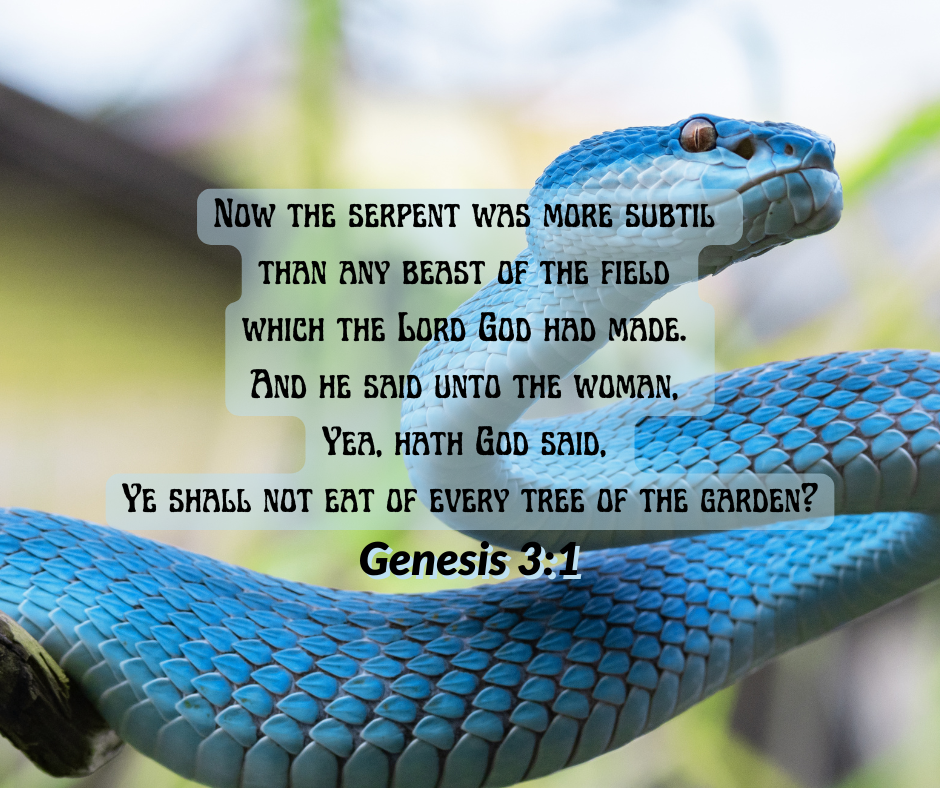
The serpent’s distortion is ultimately an attack on God Himself.
God’s Truthfulness Questioned
The serpent’s strategy is theological at its core: by twisting the command, he implies that God may not be entirely honest. To entertain the question is to wonder whether God can be trusted. This is the first slander against the divine character. Genesis 3:1 thus reveals that sin is not only against law but against God Himself, whose truthfulness is placed in doubt.
Yet Scripture is unequivocal: God “is not a man, that He should lie” (Numbers 23:19), and His Word is truth (John 17:17). To suggest otherwise is to invert reality. The serpent’s whisper does not merely distort a command; it maligns the character of the One who gave it. This is why doubting God’s truthfulness is the essence of rebellion.
For believers today, the application is immediate. Whenever we treat God’s promises as uncertain, or His commands as negotiable, we repeat the first sin. The serpent’s question lives on whenever God’s integrity is made suspect. Theology proper insists: God cannot lie, and His Word stands firm.
God’s Goodness Distorted
The serpent not only questions God’s truth but casts suspicion on His goodness. By exaggerating the prohibition, he implies that God is stingy, withholding what could enrich human life. This subtle reframing makes divine generosity appear restrictive.
But the reality was the opposite: God had given every tree except one. His generosity was abundant, His restriction minimal. Genesis 3:1 thus illustrates how sin begins when divine goodness is reinterpreted as divine stinginess. It is the ancient version of what Paul diagnoses in Romans 1: exchanging the truth of God for a lie.
In our own lives, the same distortion creeps in whenever we imagine God’s commands as obstacles to joy rather than pathways to it. The serpent’s strategy remains potent precisely because it reframes obedience as deprivation, when in fact God’s commands are gifts meant for our flourishing.
God’s Generosity Overlooked
The most tragic element of the serpent’s distortion is how it blinds humanity to God’s generosity. Eve should have seen the garden as a theater of divine kindness. Instead, her gaze was narrowed to the single restriction. Genesis 3:1 exposes the ease with which abundance is forgotten when doubt takes root.
Theology proper insists on the opposite perspective: “God richly provides us with everything to enjoy” (1 Timothy 6:17). To question His generosity is to misread creation itself. The serpent’s lie was not only false; it was blind to the overwhelming evidence of divine provision.
For us, the takeaway is clear. Gratitude is not optional; it is protection. When we rehearse God’s generosity, we inoculate ourselves against the suspicion that He is holding out on us. Genesis 3:1 calls us back to thanksgiving as the posture that resists temptation and honors the Giver.