
A Creature Twisted for Deception
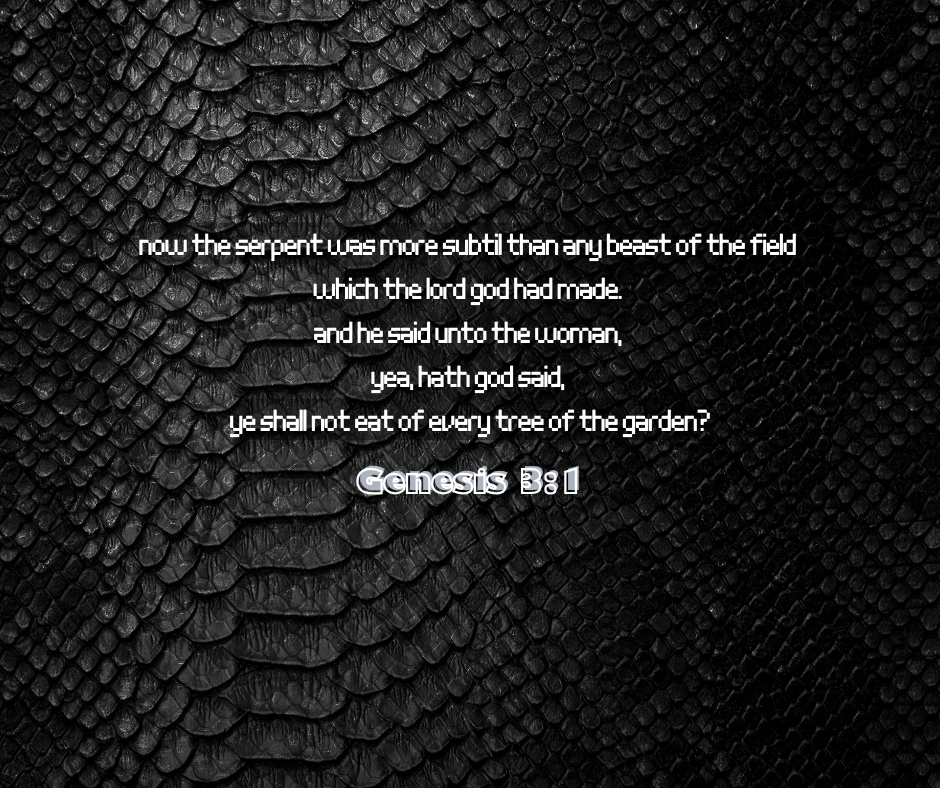
Genesis 3 opens with words that feel both brief and ominous: “Now the serpent was more subtil than any beast of the field which the LORD God had made.” At first glance, this may appear to be nothing more than a curious detail about a particularly clever animal in God’s creation. The Hebrew word for “serpent” certainly allows for that straightforward reading; it is the ordinary term for a snake. Yet the narrative quickly reveals that this serpent is not ordinary at all. What begins as a description of a creature soon unfolds into an encounter with the adversary himself, working through the serpent as his mouthpiece.
Later Scripture confirms what Genesis only hints at: the serpent is more than an animal; he is the instrument of Satan. The book of Revelation identifies him plainly as “that old serpent, called the Devil, and Satan, which deceiveth the whole world” (Revelation 12:9; 20:2). The subtle deceiver in Eden is the same figure who, throughout history, wages war against God and His people. This continuity ties the first temptation in Genesis directly to the larger drama of redemption that stretches across the whole Bible.
It is also significant that the narrator presents the serpent first and foremost as a creature “which the LORD God had made.” In other words, he is not an independent rival to God, nor an equal force of darkness in some dualistic struggle. He is a created being, part of the world that God declared “very good” (Genesis 1:31), but now enlisted in rebellion. His cunning will soon become the tool by which humanity is enticed to doubt God’s Word and distrust His goodness. By introducing the serpent in this way, Scripture sets the stage for one of its central truths: evil is not co-eternal with God but arises within creation as defiance against Him. The serpent is a creature, but one whose subtlety is about to become the catalyst for humanity’s tragic fall.
The Subtlety of the Serpent
The key word in the verse, “subtil” (ʿārûm), is richly nuanced. In other parts of Scripture, particularly in Proverbs (Proverbs 12:16, 23), the same root can carry a positive sense of prudence, insight, or careful discernment. Shrewdness, in that context, is a sign of wisdom. Yet in Genesis 3, the nuance turns darker: the serpent’s subtlety is not life-giving but manipulative, not prudent but predatory. Interpreters differ on how to read this. Daniel Block argues that the serpent represents a kind of “wisdom not based on the fear of the Lord,”1 knowledge divorced from reverence for God, which Proverbs insists is the only true foundation of wisdom (Proverbs 9:10). John Walton similarly notes that shrewdness, when untethered from godly fear, becomes corrosive rather than constructive.2 John Davis offers another angle, suggesting that the word itself need not be taken negatively, but simply describes the serpent’s cleverness, which in turn made it a fitting vessel for Satan’s schemes.3
The narrator, however, seems to nudge the reader toward a negative reading through a striking wordplay. At the close of Genesis 2, Adam and Eve are described as “naked” (ʿărûmmîm), open and unashamed before one another and before God (2:25). Immediately afterward, the serpent is described as ʿārûm, subtil. The echo is intentional: the innocent vulnerability of humanity will now be confronted by a cunning adversary eager to exploit it. Innocence and subtlety are placed side by side, preparing us for a conflict where trust in God’s truth will be pitted against deception.4
Taken together, the literary and theological context suggests that ʿārûm here is no neutral descriptor. It is a signal of danger. What Proverbs celebrates as wise discernment has been twisted into craftiness, sharpened not for life but for destruction. The serpent may be part of God’s creation, but his subtlety is set against God’s goodness, and his cleverness is marshaled in service of rebellion. In just a few words, Genesis alerts us that the harmony of Eden is about to be tested and that the battle will not begin with swords or strength, but with words.
The Serpent’s Distortion of God’s Word
The serpent’s first recorded words in Scripture are nothing short of striking: “Yea, hath God said, Ye shall not eat of every tree of the garden?” (Genesis 3:1). This is the earliest instance of a non-human creature speaking in the biblical narrative, and its form is deliberate. It is not an outright contradiction of God’s word, but a subtle distortion of it. God’s original command was overwhelmingly generous: “Of every tree of the garden thou mayest freely eat” (Genesis 2:16). Only one tree was placed off limits. Yet the serpent reframes this abundant permission as an unreasonable restriction, as though God were more interested in withholding good than in granting it.
This is deception at its most dangerous: not bold-faced lies, but questions designed to twist perspective. Victor Hamilton captures the force of the serpent’s insinuation: “This God of yours is holding back from you. He lets you see, but not enjoy. Can you really trust a God like that?”5 Henry Morris likewise notes that the suggestion was subtle: perhaps God was not as good or as loving as Adam and Eve had assumed.6 By planting this seed of doubt, the serpent calls God’s character into question. He does not need to prove God false; he only needs to make Him appear less generous, less trustworthy, less good.
R. R. Reno underscores how the serpent achieves this by introducing ambiguity. The command, which was clear and straightforward, suddenly feels uncertain. Was it really every tree? Was the restriction broader than they had understood? If the boundary lines are blurry, then perhaps they can be redrawn. Once the authority of God’s word is destabilized, reinterpretation and even outright dismissal become thinkable. The serpent’s question thus creates a disorienting fog in which rebellion begins to look reasonable.7
In this way, Genesis shows us the anatomy of temptation: it does not begin with a denial of God’s existence, but with a distortion of His generosity. It shifts the focus from what God freely gives to what He withholds, from abundance to restriction, from grace to grievance. With a single question, the serpent recasts the Lord of life as a miser, and obedience as oppression. That same strategy remains recognizable in every age, for the ancient whisper still lingers: “Hath God said…?”
The Subtle Shift: Omitting the LORD
Another subtle but revealing detail lies in the serpent’s use of God’s name. Throughout Genesis 2, the narrative consistently refers to Him as YHWH Elohim, “the LORD God.” This pairing is significant. Elohim emphasizes God’s majesty and creative power, while YHWH, His covenant name, underscores His personal relationship and faithfulness to His people. Together, the two titles keep before the reader both God’s transcendence and His nearness, His greatness and His grace.
But when the serpent speaks in Genesis 3:1, the covenant name YHWH is conspicuously dropped. He refers to God only as Elohim. At first glance this might seem like an inconsequential variation, but its effect is profound. The serpent subtly reframes God, not as the intimate Lord who walks with His creatures, but as a distant deity, majestic perhaps, but detached, impersonal, and less approachable. Wenham observes that Eve mirrors this linguistic shift in her reply (3:2–3), already showing signs that the serpent’s framing has begun to alter her perception of who God is.8
This is no minor narrative quirk; it is a theological insight into how temptation works. Sin rarely begins with outright atheism, an open denial of God’s existence. Instead, it begins with distortion. The serpent does not say, “There is no God,” but rather presents Him as less than He truly is. He recasts the covenant LORD as a remote lawgiver, one whose commands may be questioned and whose character may be doubted. Once God is seen as distant, His Word feels negotiable. Once His goodness is questioned, His commands feel burdensome.
Here lies the danger: the fall begins not in the hand that takes the fruit, but in the heart that entertains a diminished view of God. The serpent’s omission of YHWH is a subtle strategy to erode trust. It is a reminder that spiritual deception often comes not with a shout of denial but with a whisper of distortion, turning the God who is near, faithful, and good into someone cold, withholding, and suspect. The ancient tactic remains familiar: temptation begins not with rejecting God outright, but with believing less about Him than He has revealed Himself to be.
In the end, Genesis 3:1 introduces more than a serpent; it introduces the first challenge to God’s goodness and truthfulness. The verse marks the shift from creation’s harmony to a contest of trust, where God’s clear and generous word is subtly reframed as restrictive. The heart of the temptation is not about fruit but about faith: whether humanity will believe the Lord who gives life or entertain suspicion about His character. This single question—“Hath God said?”—becomes the seed of all later rebellion, a pattern of deception that continues to echo in every age.
- Daniel I. Block, study notes on Genesis, in Everyday Study Bible (Nashville: Holman Bible Publishers, 2018). ↩︎
- John H. Walton, Genesis, NIV Application Commentary (Grand Rapids: Zondervan, 2001), 204. ↩︎
- John J. Davis, Paradise to Prison (Salem: Sheffield Publishing Company, 1975), 86-87. ↩︎
- Allen P. Ross, “Genesis,” in The Bible Knowledge Commentary: Old Testament, ed. John F. Walvoord and Roy B. Zuck (Colorado Springs: Chariot Victor Publishing, 1985), 32. ↩︎
- Victor P. Hamilton, “Genesis,” in Baker Commentary on the Bible, ed. Walter A. Elwell (Grand Rapids: Baker Books, 1989), 13. ↩︎
- Henry M. Morris, The Genesis Record (Grand Rapids: Baker Books, 1976), 110. ↩︎
- R. R. Reno, Genesis (Grand Rapids: Brazos Press, 2010), 85-86. ↩︎
- Gordon J. Wenham, Genesis 1–15, Word Biblical Commentary 1 (Grand Rapids: Thomas Nelson, 1987), 73. ↩︎