
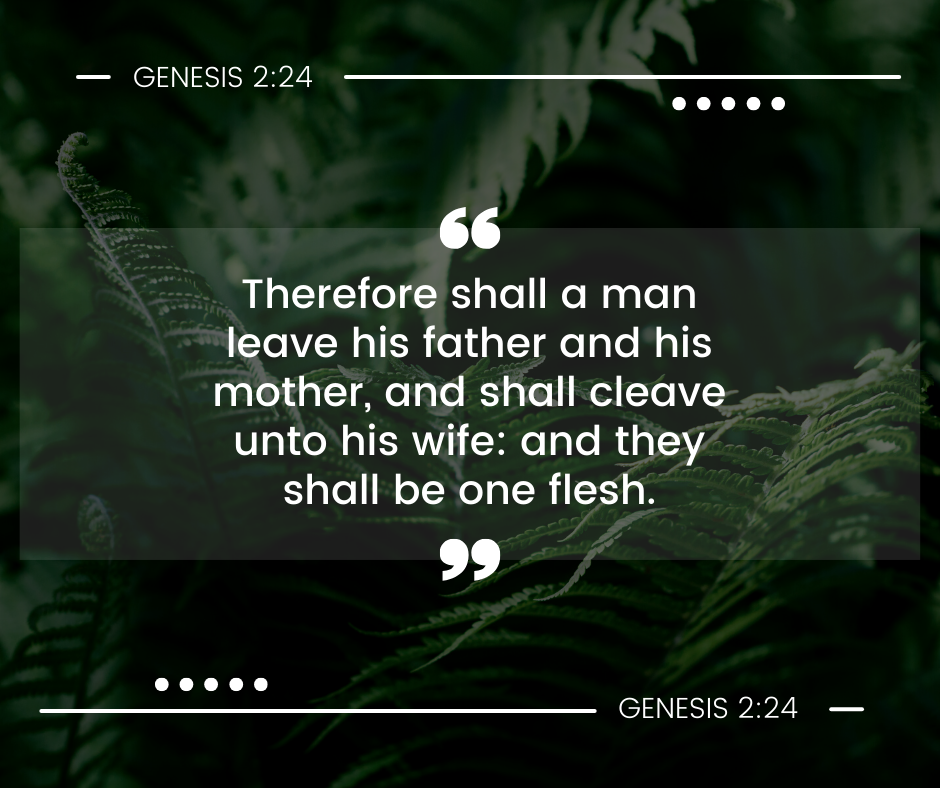
It’s easy to read Genesis 2:24 as if it were simply describing Adam and Eve’s wedding day, but the Hebrew grammar signals something far broader. The verbs in this verse (yiqtol forms joined with conjunctions) are what scholars call gnomic; they describe what is generally and permanently true, not just what happened once.1 In other words, this verse is not a diary entry about Eden; it is a divine declaration about how marriage is meant to be in every generation.
That means Genesis 2:24 stands as a kind of creation charter for marriage. It is God Himself who sets the pattern: a man leaves his parents, cleaves to his wife, and the two become one flesh. Later biblical writers understood this. Jesus quotes the verse not as an ancient curiosity but as a present command: “What therefore God hath joined together, let not man put asunder” (Matthews 19:6). Paul does the same in Ephesians 5, grounding Christian marriage ethics in this creation word.
The significance is hard to overstate. Genesis 2:24 isn’t locked in the past; it defines what marriage is at its core, across time and culture. Whether in Eden, in Israel, or in the church today, God’s design remains the same: one man and one woman joined in covenant faithfulness, forming a new family unit that reflects His wisdom and love. Far from being a quaint relic, this verse continues to speak into our modern world, calling us back to God’s good design.
- J. A. Cook, The Biblical Hebrew Verbal System, doctoral dissertation (University of Wisconsin–Madison, 2002), https://ancienthebrewgrammar.wordpress.com/wp-content/uploads/2010/05/cook-2002_bhvs_uwdiss.pdf (accessed August 24, 2025). ↩︎