
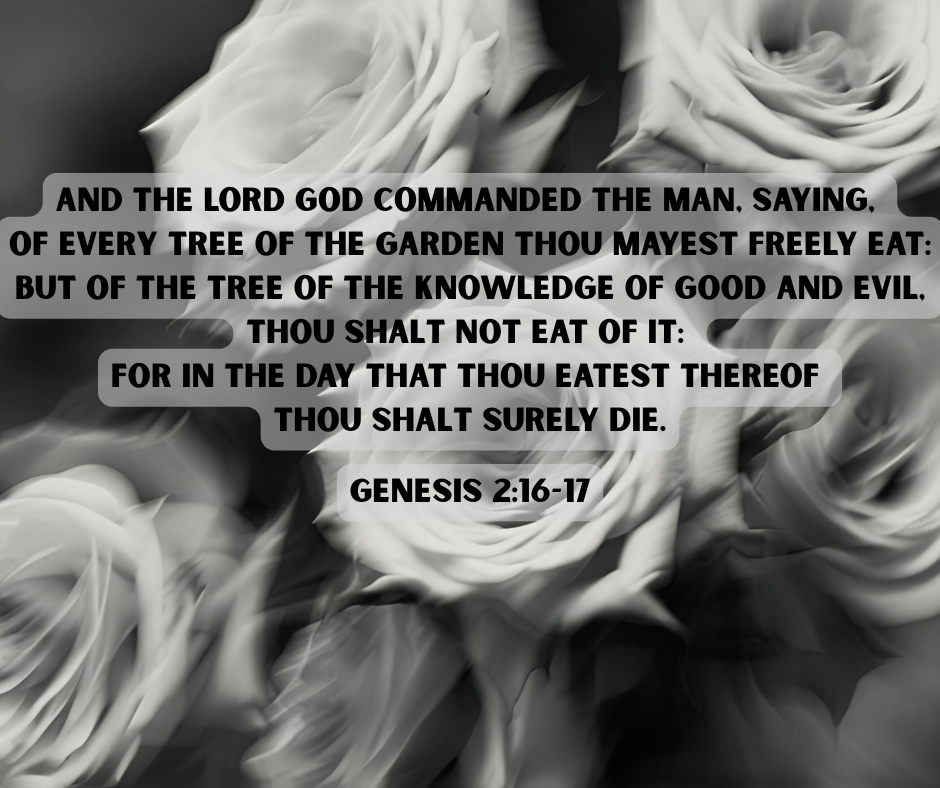
While the authority and clarity of God’s Word are unassailable, it is both wise and necessary for faithful Christians to engage with the common objections raised against foundational texts such as Genesis 2:16–17. These criticisms, often leveled from secular, skeptical, or liberal theological perspectives, do not diminish the truth of Scripture, but they do call us to give thoughtful, biblical, and compassionate answers. As Jude exhorts, we are to “earnestly contend for the faith which was once delivered unto the saints” (Jude 3), and as Peter commands, we must always be “ready to give an answer” with “meekness and fear” (1 Peter 3:15).
“Why would a loving God place a forbidden tree in paradise?”
Objection: The placement of the tree of the knowledge of good and evil seems like entrapment, an unnecessary temptation that set humanity up to fail.
Biblical Response: The tree was not a trap but a covenant signpost, an outward symbol of an inward relationship. In giving Adam this single command, God affirmed man’s dignity as a moral agent capable of trust and obedience. Freedom without the capacity to choose is not freedom at all. The presence of the tree established the moral reality of Eden: that paradise is sustained not by moral neutrality or automation, but by love, faith, and trust in God’s authority. The command was a gracious call to humility, not a harsh restriction. It taught that God alone defines good and evil, and that true liberty is found in submission to His will.
“Isn’t the punishment—death for all humanity—too extreme for one act of disobedience?”
Objection: The death penalty seems disproportionate to the offense. Why should eating a piece of fruit bring death upon the entire human race?
Biblical Response: The issue was not fruit; it was rebellion. Disobeying God’s express command was a moral revolt against the very source of life. Sin is not merely the breaking of a rule; it is the rejection of the Ruler. As Paul explains, “the wages of sin is death” (Romans 6:23). Adam acted not only as an individual but as the federal head of humanity (Romans 5:12–19; 1 Corinthians 15:22). His sin introduced spiritual death (alienation from God), physical death (mortality), and eternal death (judgment). The severity of the penalty highlights both God’s perfect holiness and the high cost of sin, not because God is unjust, but because He is infinitely just and cannot deny His own character.
“How could Adam know disobedience was wrong before knowing good and evil?”
Objection: If Adam and Eve lacked the knowledge of good and evil, how could they understand the moral gravity of disobedience?
Biblical Response: Adam did not lack moral awareness, he had God’s clear command. He knew what was right because God told him. The knowledge in question was not about information, but about authority: who gets to define what is good and evil? To obey God was to trust Him as the source of all wisdom. To eat of the tree was to claim that moral autonomy. Adam and Eve were not blank slates; they were created “in the image of God” (Genesis 1:27) and “upright” (Ecclesiastes 7:29). Their failure was not due to ignorance, but to unbelief, a willful decision to question God’s goodness and seize self-rule.
“Didn’t God say they would die ‘in the day’ they ate, but Adam lived centuries longer?”
Objection: Genesis 2:17 says, “in the day that thou eatest thereof thou shalt surely die,” yet Adam lived 930 years (Genesis 5:5). Was God wrong?
Biblical Response: The phrase “thou shalt surely die” (מוֹת תָּמוּת, mōt tāmūt) is a Hebrew idiom emphasizing the certainty and totality of death (Testa, 2024). Adam died spiritually the moment he disobeyed. His fellowship with God was broken (Genesis 3:8). He experienced shame, fear, hiding, and estrangement. Physically, he began to die; the process of decay was initiated. Ultimately, without grace, this trajectory leads to eternal separation from God, the second death (Revelation 20:14). Thus, God’s word was fulfilled in every dimension: spiritual, physical, and judicial.
“Isn’t this just a myth? A magical tree granting moral knowledge?”
Objection: The account of a tree that imparts moral awareness sounds like ancient mythology, not history.
Biblical Response: The tree had no magical powers. It did not impart moral knowledge like a potion; it marked the boundary of moral jurisdiction. The act of eating was not about ingesting ethics but about rejecting divine authority. Genesis uses historical narrative, not mythopoetic symbolism. The knowledge of good and evil represented the human claim to define right and wrong apart from God, something that belongs to Him alone (Isaiah 5:20). The effects of their disobedience—shame, hiding, blame-shifting, curse, and death—show that the tree functioned covenantally, not mythically.
“Isn’t the command too arbitrary, a petty rule rather than a real moral principle?”
Objection: Why would God make a rule about eating from a tree instead of addressing more substantial moral issues?
Biblical Response: The command was not arbitrary but deeply theological. It asked: Will man live under God’s rule or seek self-rule? This is the most profound moral question possible. It echoes throughout Scripture: Will we trust the Lord or follow our own ways? The simplicity of the command only magnifies the sin, there was no hardship, no confusion, no excuse. Obedience was not burdensome (1 John 5:3); it was relational and based on trust. The command pointed directly to the Creator-creature distinction and required reverent submission to God’s Word.
“If God knew they would fall, did they really have free will?”
Objection: God’s foreknowledge of the Fall seems to invalidate human freedom. How can it be a real choice if the outcome was predetermined?
Biblical Response: God’s omniscience does not cancel human responsibility. Divine foreknowledge is not the same as fatalism. Scripture affirms both God’s sovereign decree and man’s real choice (Acts 2:23). The Fall did not surprise God, but neither did He coerce it. Rather, He ordained a plan that would reveal both justice and mercy in Christ, the Second Adam (Romans 5:19). The cross was not a contingency plan, but “the Lamb slain from the foundation of the world” (Revelation 13:8). Far from undermining freedom, this reveals God’s redemptive wisdom in turning even rebellion into the occasion for redemption.
“Isn’t this contrary to human nature? Weren’t Adam and Eve just naturally curious?”
Objection: Expecting early humans to obey such a command seems unrealistic. Curiosity is hardwired into human beings.
Biblical Response: Curiosity, rightly ordered, is part of human nature. But moral responsibility is not overruled by impulse. Adam and Eve were not pre-programmed beings; they were morally upright and capable of choosing obedience. Scripture does not present them as primitive or ignorant, but as rational, relational, and created “very good” (Genesis 1:31). The issue was not curiosity, but unbelief. They had everything yet doubted the One who gave it. Their sin was not in seeking knowledge, but in seeking it apart from God.
Conclusion: The Wisdom of God’s Command Still Stands
Genesis 2:16–17 remains a theological cornerstone. Far from being primitive or problematic, it reveals eternal truths about God’s holiness, man’s moral responsibility, and the necessity of divine redemption. The objections raised by skeptics are not new. They echo the same lie the serpent spoke in the garden: “Yea, hath God said?” (Genesis 3:1). But the answer has not changed.
God did say, and He has not stuttered. His law is good. His justice is righteous. And His grace, through Jesus Christ, is glorious beyond measure. The prohibition in Eden is not a footnote to the gospel; it is its prelude. The same God who declared death for sin has declared life through the cross. Therefore, let us uphold the truth, answer objections with conviction and clarity, and proclaim the unchanging message: “In Adam all die… even so in Christ shall all be made alive” (1 Corinthians 15:22).