
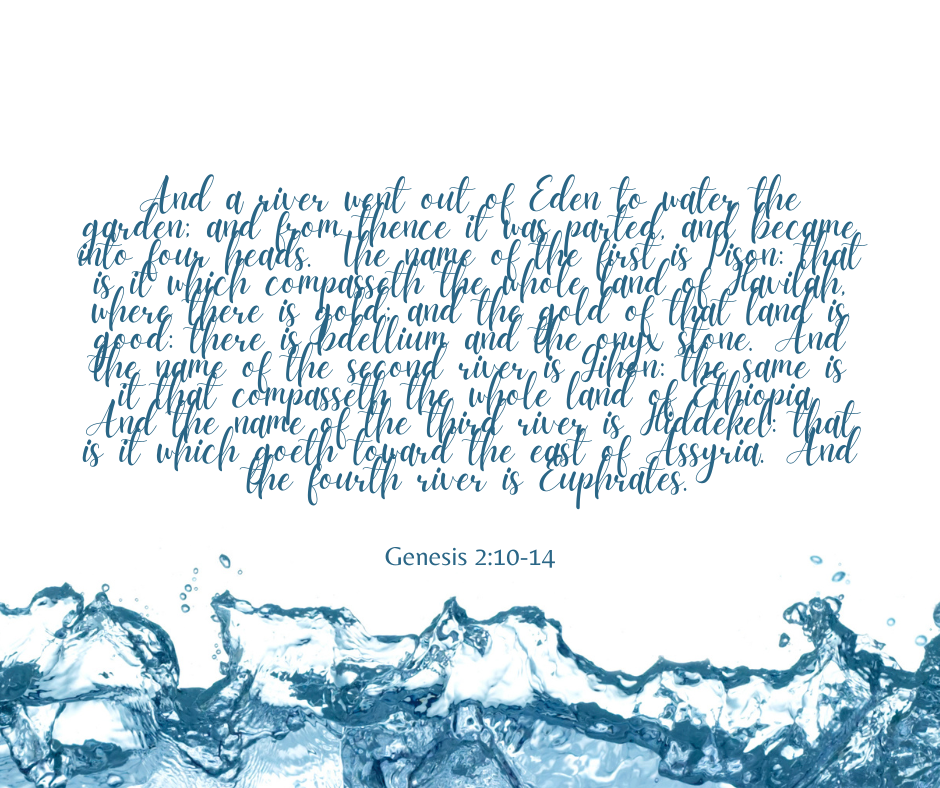
Genesis 2:10–14, with its depiction of a life-giving river dividing into four named streams, has frequently been compared to river imagery in ancient Near Eastern mythologies. Critics suggest that this biblical account draws from or reworks motifs present in Sumerian, Akkadian, and Babylonian narratives, particularly myths that feature sacred gardens, cosmic rivers, and paradisiacal realms. Yet such comparisons often conflate superficial resemblance with literary dependence and fail to account for the radical theological and cosmological divergence embedded in the biblical text.
Where mythological traditions portray rivers as manifestations of divine essence or mystical power, the Genesis narrative grounds its river system in history, geography, and covenant. It offers not a symbolic cosmos governed by capricious deities, but a real creation sustained by the one true God. This distinction is not subtle, it is fundamental.
Contrasts in Cosmology: Mythic Chaos vs. Providential Order
In Mesopotamian texts such as the Enuma Elish or the Epic of Gilgamesh, rivers and water sources emerge from divine conflict or as extensions of the gods themselves. For example, in the Epic of Gilgamesh, sacred gardens appear near the realm of the gods, surrounded by rivers and trees bearing gemstones, a setting detached from any earthly geography (Tigay, 2002). In the myth of Dilmun, a primeval paradise is watered by canals sent from gods and untouched by disease or death (Kramer, 1998). These watercourses are often born from divine bodies or thrones, reflecting a pantheistic worldview where nature is divine and creation is the result of struggle or accident.
By contrast, Genesis introduces a river that peacefully “went out of Eden to water the garden” (Genesis 2:10). It is not divine, nor does it emerge from divine conflict. It flows from a garden planted intentionally by God, a real, physical space designed for the flourishing of life. The river’s division into four heads is not cosmic allegory but part of God’s ordered creation. The God of Genesis is not within nature but sovereign over it, separate from creation yet intimately involved with it.
This distinction strikes at the heart of ancient mythologies. Pagan religions often express cyclical cosmologies, endless repetitions of death and rebirth, governed by deified natural forces. Genesis, however, presents a linear, purposeful, and historical framework: a good creation, marred by sin, and destined for restoration through God’s redemptive plan.
Geographic Anchoring vs. Mythic Abstraction
The naming of the four rivers—Pison, Gihon, Hiddekel (Tigris), and Euphrates—places the Genesis account firmly in the realm of the historical. These rivers are associated with recognizable regions and tangible resources: gold, bdellium, onyx, Cush, Assyria. Such specificity contrasts sharply with the vague and often otherworldly settings of ancient myths, where rivers are situated in heavens, underworlds, or inaccessible realms.
For instance, the river that waters the mythic paradise in Gilgamesh is never geographically defined. Its setting is symbolic, marking the boundary between mortality and divine wisdom (Thackara, 1999). Likewise, in Egyptian cosmology, the Nile is viewed not merely as a river but as the bloodstream of gods, its annual flooding interpreted as the pulse of divine favor (Oestigaard, 2005). These rivers are not locations to be visited; they are metaphysical currents within a sacred drama.
Genesis, however, treats rivers as part of God’s material provision. The resources mentioned in Havilah—gold, bdellium, onyx—reappear in the construction of Israel’s tabernacle and priestly garments (Exodus 25–28), linking Eden to later sacred spaces. This continuity is theological as well as geographic: Eden is the first sanctuary, and the river is not merely irrigation but a symbol of God’s sustaining grace.
Symbolism with Substance: Reclaiming the Fourfold Flow
Many ancient cultures, such as the Persians, Egyptians, and Ugaritians, imbued the number four with symbolic meaning: the four winds, directions, or zones of the earth. Zoroastrian texts describe four rivers flowing from the cosmic mountain Hara Berezaiti, believed to nourish the entire world (Boyce, 2000). Egyptian texts depict divine rivers flowing from the sun god’s throne to irrigate the four corners of the earth (Hornung, 1999).
Genesis does not deny this symbolic richness, but it reorients it. The four rivers in Genesis are not mystical emanations or symbolic quadrants of a divine being. They are actual rivers, described in concrete terms. Yet their division still conveys a broader truth: God’s blessing extends to the whole earth. The symbolism is grounded in substance. The number four signals completeness, not abstraction, a creation fully provided for, under the dominion of its Creator.
Where pagan myth elevates rivers into esoteric signs of divine essence, Genesis uses them to demonstrate God’s immanence and generosity in the natural world. The Edenic river system is not about spiritual ascent or cosmic balance; it’s about covenant provision, physical sustenance, and the spreading of divine order.
Shared Memory, Not Borrowed Myth
From a biblical perspective, the similarities between Genesis and ancient mythologies are best explained not by literary dependence but by shared ancestral memory. After the dispersion at Babel (Genesis 11), scattered nations preserved distorted memories of Eden, the Flood, and early humanity. These echoes became the myths of later civilizations, fragments of truth wrapped in cultural embellishment and theological error.
This explains why so many pagan myths include rivers, gardens, or trees of life. These are not sources of the Genesis account, but corrupted memories of the original events later recorded faithfully in Scripture by divine revelation. Genesis stands in contrast not only in content but in tone: where myth confuses, Genesis clarifies; where myth spiritualizes, Genesis historicizes; where myth deifies nature, Genesis exalts the Creator.
Moreover, only Genesis embeds its narrative in a redemptive arc. While myths like Gilgamesh seek immortality in vain, Genesis traces a path from lost Eden to restored paradise. The river that flowed from the first garden reappears in Revelation 22:1–2, flowing “from the throne of God and of the Lamb,” watering the tree of life and healing the nations. This is not a cyclical myth, it is linear fulfillment.
Rivers That Flow with Grace and Truth
Ancient religions portrayed rivers as thresholds between worlds, reservoirs of divine force, or symbols of unknowable power. Genesis declares something entirely different: rivers as gifts. Their purpose is not to mystify, but to bless. They water the garden, they nourish creation, and they testify to the goodness of God.
Genesis 2:10–14 does not borrow from myth; it speaks into a myth-saturated world with clarity and truth. It replaces mysticism with meaning, and abstraction with historical reality. It presents a garden not of the gods, but of the one true God, a place of order, beauty, and provision, created not in conflict but by command. Its river system is both literal and theological, flowing from the Creator to the world, from blessing to mission.
In a world of echoes and shadows, Genesis offers the original voice. Its rivers still speak, not as symbols of mystery, but as signs of grace. They remind us that Eden was real, that God’s provision is purposeful, and that, in Christ, the river of life will one day flow again from God’s throne to the nations (Revelation 22:1–2).