
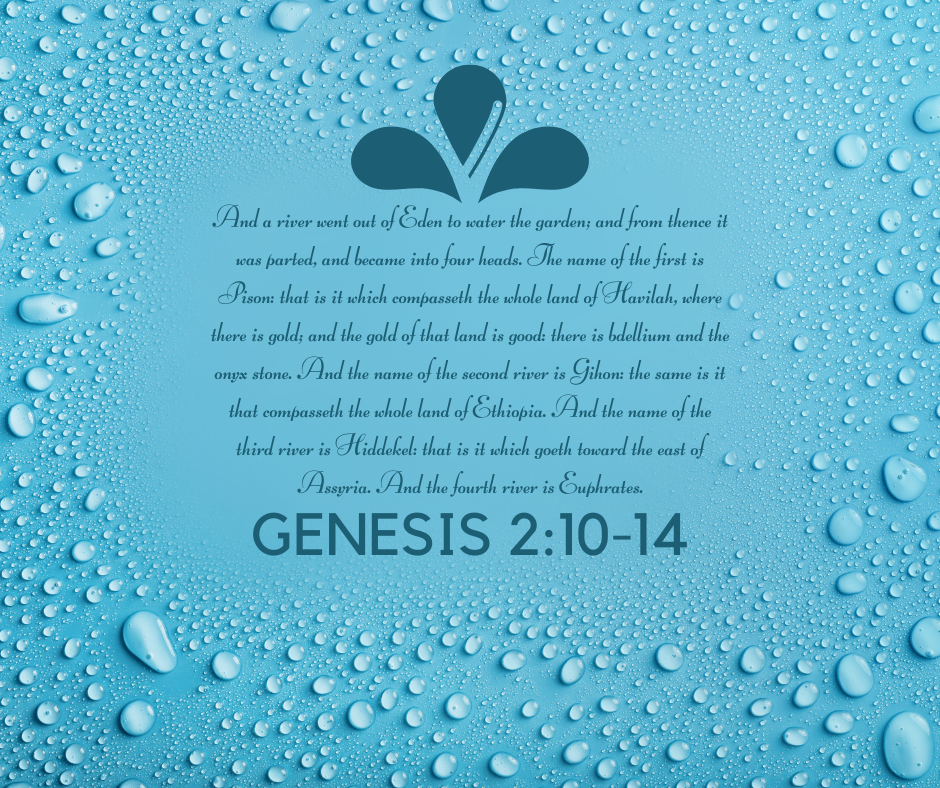
Throughout the early centuries of the Church, various Christian thinkers sought to interpret the rivers of Eden not merely as literal waterways, but as symbols of deeper spiritual truths. While their intentions were often pastoral or theological, many of these interpretations leaned heavily on allegory and mystical symbolism, practices that, though initially restrained, eventually contributed to a tradition of reading Scripture that prioritized abstract meaning over historical reality. This approach, though influential, laid a foundation for later departures from the plain sense of God’s Word.
Allegorical and Spiritual Readings
Origen of Alexandria (c. 185–254 AD), one of the earliest and most influential allegorical interpreters, viewed the Edenic river as divine wisdom or the Holy Spirit, with the four rivers representing the Gospels or cardinal virtues. Eden itself, for Origen, symbolized the soul’s ideal, pre-fallen condition. While Origen’s spiritual insights were sometimes profound, his method frequently downplayed or dismissed the literal meaning of the biblical text in favor of speculative theology. He drew heavily from Platonic philosophy, and his allegorization often bore more resemblance to Hellenistic thought than to the covenantal framework of Scripture (1982).
Though later theologians would retain some of Origen’s exegetical innovations, his approach ultimately introduced a hermeneutic that made Scripture vulnerable to reinterpretation based on external philosophical systems. The shift from a historical to a symbolic Eden opened the door to the theological relativism seen in later mystical and Gnostic movements.
Sacramental and Ecclesiological Applications
Cyprian of Carthage (c. 200–258 AD) maintained a more ecclesially grounded symbolism. He saw the four rivers as figures of the four Gospels flowing from Christ, the source of all grace, and envisioned the Church as a new Eden, where believers are planted and nourished by the Word. Though less speculative than Origen, Cyprian’s interpretation still moved beyond the text’s historical claims and introduced symbolic layers that, while edifying, were not explicitly grounded in the Genesis narrative itself (Tutkovski, 2023).
Ambrose of Milan (c. 340–397 AD) followed a similar line, presenting the rivers as images of grace flowing throughout the earth via the Church’s mission (Schaff). Ambrose’s theological emphasis on the outpouring of Christ’s grace was faithful in tone and purpose, but his symbolic reading nonetheless contributed to a growing tradition of non-literal interpretation. Even when the doctrinal content was sound, the method subtly reinforced the idea that the historical setting of Eden could be reimagined in service of theological constructs.
Augustinian Integration of Literal and Symbolic Meaning
Augustine of Hippo (354–430 AD) attempted to bring balance to the conversation by affirming both the historical reality of Eden and the possibility of symbolic meaning. He associated the four rivers with the four cardinal virtues or categories of human knowledge, integrating classical thought with biblical theology in a more cautious and theologically reflective manner (2015). Augustine’s commitment to the literal sense of Scripture gave his symbolic interpretations more stability and doctrinal soundness than those of his predecessors.
However, even Augustine’s carefully constructed typologies contributed to a trajectory in which allegory and abstraction began to obscure the original, covenantal context of the biblical narrative. While Augustine did not reject the historical truth of Genesis, his influence helped solidify a model of interpretation that gave future generations justification to read almost any passage as a metaphor rather than fact.
Ephrem’s Mystical Interpretation
Ephrem the Syrian (c. 306–373 AD) offered a poetic and devotional reflection on the Edenic rivers, emphasizing the garden’s supernatural character: “the spiritual trees of paradise had not need of water.” Ephrem viewed the rivers as channels of divine grace, not dependent on natural order but on God’s sustaining presence (Fitzgerald, 2002). Though his language is rich and reverent, it moves Genesis 2:10–14 into a mystical realm that blurs the distinction between literal history and spiritual metaphor.
While Ephrem’s intentions were not as philosophically speculative as Origen’s, his mysticism contributed to a tradition where Scripture became a canvas for imaginative theology, paving the way for later Gnostic reinterpretations. The plain meaning of the text was increasingly overshadowed by symbolic constructs untethered from the redemptive history Scripture reveals.
Conclusion
The early Christian use of allegory, symbolism, and mysticism in interpreting Genesis 2:10–14 arose from a desire to deepen spiritual understanding. Yet in doing so, many of these interpreters introduced a hermeneutical method that gradually distanced the Church from the plain, historical reading of Scripture. Though some, like Augustine, sought to maintain doctrinal fidelity and scriptural integrity, the allegorical impulse—rooted in philosophical systems foreign to the Bible—set a precedent for increasingly speculative theology.
Over time, what began as devout meditation gave way to esoteric reinterpretations, obscuring the clear testimony of God’s Word. The rivers of Eden, intended in Scripture as real provisions within a real creation, became symbols subject to shifting meanings. For those committed to the authority, clarity, and sufficiency of Scripture, this trajectory serves as a cautionary tale: when human imagination overtakes divine revelation, the result is not deeper understanding but theological confusion.