
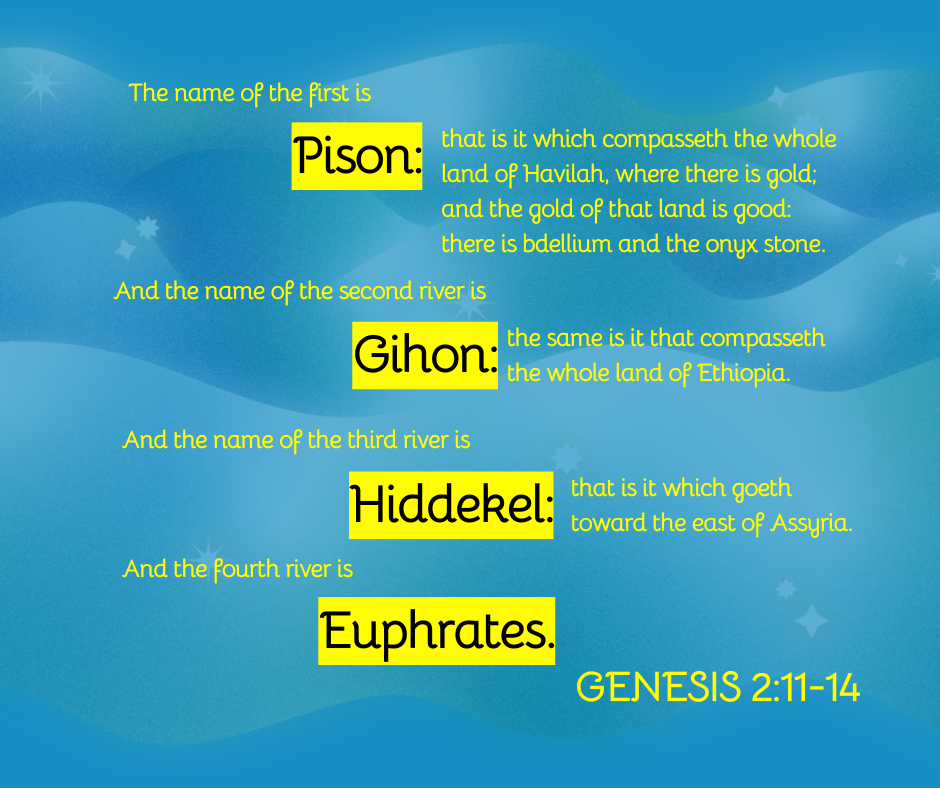
Genesis 2:11–14 provides the Bible’s only direct geographical description of the Garden of Eden. It speaks of a single river flowing out of Eden, which parts into four distinct “heads” or river branches: Pison, Gihon, Hiddekel, and Euphrates. While the identity of some of these rivers remains uncertain, the passage offers a meaningful glimpse into the abundance, order, and harmony of God’s original creation. Though rich in theological significance and suggestive of themes later developed in Scripture—such as covenant, priesthood, judgment, and the extension of God’s blessing to the nations—this description should be approached primarily as a historical narrative rather than as a mere allegory. While symbolic meanings can rightly be drawn from the text, care must be taken not to impose speculative or overly spiritualized interpretations that obscure its literal and foundational role in the creation account.
The Pison River
The Pison is the first river mentioned and is described as encircling the land of Havilah, a region noted for its wealth in gold, bdellium, and onyx stone. Of the four rivers, the Pison remains the most obscure in terms of identification. Ancient historians and theologians proposed a variety of possible locations. The Jewish historian Josephus associated the Pison with regions in Arabia (1965), while Church Fathers such as Ephrem the Syrian identified it with the Danube, and both Ambrose and John of Damascus suggested it was the Ganges (Oden, 2001). These identifications reflect attempts to connect biblical geography with the known world of their time.
Modern scholarship has also attempted to identify the Pison. Some geologists and archaeologists, aided by satellite imaging, have traced an ancient, now-dry riverbed in Saudi Arabia that runs from the Hijaz Mountains near Medina northeast toward the Persian Gulf. This river, which likely dried up between 3500 and 2000 B.C., may correlate with the biblical Pison. Notably, this region is home to Mahd adh-Dhahab, or the “Cradle of Gold,” a site historically recognized as one of the richest gold mines in the area. It also produces aromatic resins and precious stones, which matches the biblical description of Havilah (2001, p. 169).
Commentators such as John Gill viewed the Pison’s surrounding wealth as indicative of the goodness and abundance of God’s original creation (1999). Matthew Henry took a more spiritual interpretation, suggesting that the mention of gold and precious stones symbolized the spiritual riches and beauty embedded in Eden, serving as a reflection of God’s glory and provision (1997).
The Land of Havilah
The land of Havilah, encircled by the Pison, is repeatedly mentioned throughout Scripture. It appears in genealogical and geographical contexts in Genesis 10:7 and 10:29 and is referenced again in 1 Samuel 15:7. Havilah is traditionally associated with regions known for natural wealth and trade, possibly located in Arabia, southern Mesopotamia, or northeast Africa.
Though the exact location remains uncertain, the biblical portrayal of Havilah underscores God’s provision. Again, the land is specifically described as containing good gold, bdellium, and onyx—all elements with both material and symbolic significance. The description of its riches may signify not merely economic prosperity but also the goodness of the untainted earth before sin entered the world. According to Matthew Henry, these blessings were intended for man’s comfort and service, not his corruption (1997). Daniel I. Block (Block, 1997) and Bergen (2018) also caution that while a post-Flood land called Havilah existed during the time of Israel’s monarchy, the Havilah of Genesis 2 may have been a different pre-Flood location. Nevertheless, the Genesis text presents the land as though it was recognizable to its audience, suggesting continuity in biblical geography and theology.
Gold in Eden
Gold, mentioned in Genesis 2:12, is notable as the first metal referenced in the Bible, and is immediately qualified as “good.” This mirrors the repeated affirmation in Genesis 1 that all creation was “good,” reinforcing the idea that the material world—when uncorrupted—is a reflection of God’s goodness. In the biblical narrative, gold becomes one of the most revered and symbolic materials, used to construct sacred items within the tabernacle (Exodus 25:11) and Solomon’s temple (1 Kings 6:22).
Gold in Eden was pure and untainted, unmarred by greed or idolatry. John Gill remarked that it was a token of God’s generosity in creation, offered not for covetousness but for benefit and beauty (1999). Later Scripture maintains gold’s association with divine glory and eternal value. In Revelation 21:18, the city of New Jerusalem is described as being made of “pure gold, like unto clear glass,” highlighting the spiritual continuity from Eden to eternity. In this way, gold serves not only as a sign of wealth but as a symbol of what is holy, enduring, and heavenly.
Bdellium
Alongside gold, Genesis 2:12 mentions bdellium, a rare and fragrant resin or gum. It’s also referenced in Numbers 11:7, where the manna provided to the Israelites in the wilderness is compared in color to bdellium. Scholars believe this resin may have originated from trees in Arabia or India and was likely used in perfumery, incense, or medicinal applications.
Theologically, bdellium represents more than material wealth. As a fragrant substance, it’s connected with themes of healing, worship, and delight. Henry Morris observed that its mention alongside manna may suggest a symbolic connection to the “bread from heaven,” underscoring God’s faithful provision (1995, p. 17). Matthew Henry noted that God’s gifts in creation were not only for utility but for delight (1997), and bdellium, with its sweet aroma, reminds the reader that Eden was a place of sensory beauty as well as sustenance.
The Onyx Stone
The onyx stone, the final material mentioned in Genesis 2:12, is a precious gem that holds significant biblical meaning. Later in Scripture, onyx plays a key role in the garments of the high priest. In Exodus 28:9–12, two onyx stones are placed on the priest’s ephod, engraved with the names of the twelve tribes of Israel. These stones symbolized remembrance and intercession—bearing the names of God’s covenant people before the Lord.
In Eden, the presence of onyx suggests a foreshadowing of priestly themes, covenantal identity, and sacred mediation. It connects creation to worship and anticipates the development of Israel’s sacrificial system. Charles Spurgeon often referenced the imagery of precious stones to illustrate God’s love and remembrance of His people, portraying them as jewels remembered and treasured by the Lord (Spurgeon, 1906). Thus, the onyx in Eden is more than a beautiful gem. It points forward to the redemptive and covenantal relationship between God and His people.
The Gihon River
The second river mentioned is the Gihon, described as “compassing the whole land of Ethiopia” (Hebrew: Cush). Like the Pison, the Gihon’s identity has been the subject of extensive debate. Early church thinkers identified it with well-known rivers: Ephrem the Syrian, Ambrose, and John of Damascus identified it with the Nile (Oden, 2001).
The land of Cush may not refer to modern Ethiopia, but possibly to a now-lost or differently situated region in Arabia or Mesopotamia. Some scholars argue for a Mesopotamian Cush, suggesting the name may have referred to various peoples at different times (Burrell, 2020). Still, the association of the Gihon with Cush indicates that Eden’s influence extended far beyond its immediate borders, symbolizing the outward flow of divine blessing. The image of a river flowing to distant lands may also foreshadow the eventual spread of the Gospel to all nations.
The Land of Ethiopia (Cush)
The Hebrew term “Cush,” often translated as Ethiopia, is used in various biblical contexts to describe regions south of Egypt, including parts of Nubia and possibly Arabia. The Cushites are portrayed with complexity throughout Scripture, at times as enemies of Israel (2 Chronicles 14:9), but also as recipients of God’s mercy (Isaiah 18:1–7). Bergen observes that while a later Ethiopia was indeed located in the region of modern-day Ethiopia and Sudan, the Cush of Genesis may have referred to a pre-Flood or early post-Flood region whose precise location is now unknown (2018, p. 12).
The inclusion of Cush in the geography of Eden underscores God’s sovereign blessing upon the nations and hints at the global scope of His redemptive plan. Even in Eden, there is an implicit preview of God’s promise to bless “all the families of the earth” (Genesis 12:3), a theme fulfilled in Christ’s Great Commission to the nations (Matthew 28:19).
The Hiddekel River
The Hiddekel is identified in Genesis 2:14 as the river that flows “east of Assyria,” and it is widely recognized as the Tigris River, one of the two great rivers of Mesopotamia. The Tigris retains its ancient name even today and runs through modern Iraq.
John Calvin emphasized the clear historical references to the Tigris and Euphrates as a strong argument for the trustworthiness and historical grounding of Genesis (1554). The direction given—toward the east of Assyria—also carries symbolic weight. In Genesis 3:24, Adam and Eve are driven “east of Eden,” and throughout Scripture, movement eastward often signals exile, judgment, or distance from God. Thus, the mention of the Tigris, flowing toward the east, may foreshadow humanity’s separation from God’s presence and the need for eventual restoration.
Assyria
Assyria, mentioned alongside the Hiddekel, would later become a dominant imperial power and a major instrument of divine judgment upon Israel (Isaiah 10:5–6; 2 Kings 17). The inclusion of Assyria in Eden’s original geography is striking. It suggests that even places which would later oppose God’s people were originally part of His good creation. This inclusion affirms God’s absolute sovereignty: He knew what would come, including rebellion and exile, and yet He still laid the groundwork for redemption from the very beginning.
Assyria’s mention in Genesis points to the broader theological truth that God’s purposes encompass all nations and all history, including both judgment and mercy.
The Euphrates River
The final river named is the Euphrates, the best-known and most frequently mentioned river in the Bible. It forms one of the boundaries of the land promised to Abraham (Genesis 15:18), and it plays key roles in the rise and fall of empires and in eschatological visions (Revelation 9:14; 16:12).
Many commentators, including Matthew Poole and John Gill (1999), see the Euphrates as symbolizing both civilization and conflict. It became a boundary for empires such as Assyria, Babylon, and Persia, nations God would use for both judgment and restoration. The Euphrates serves as a historical and theological bridge from the Garden of Eden to the end of redemptive history, tying together the themes of covenant, exile, and ultimate restoration.
Conclusion
The four rivers of Eden, along with the lands and materials they encompass, serve as geographic markers, but also as deeply symbolic elements within the biblical narrative. They speak of God’s original blessing, provision, and sovereign design, while also pointing forward to the priesthood, covenant, judgment, and global mission of the gospel.
Though the precise locations may remain uncertain due to the catastrophic effects of the Flood and the passage of time, the theological truths embedded in Genesis 2:11–14 remain clear. From the garden to the nations, from gold to the river of life, this passage foreshadows the journey of Scripture itself, from Eden lost to Eden restored in Christ.