
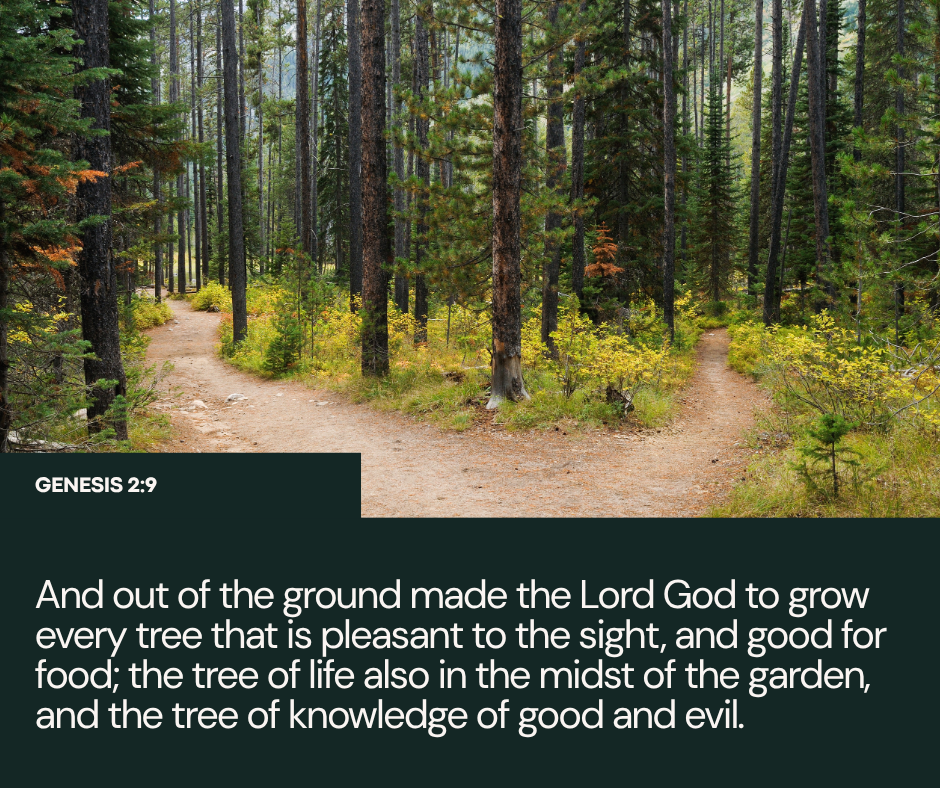
Rosicrucianism, a Western esoteric tradition interwoven with elements of mysticism, alchemy, and Hermetic philosophy, offers a radically symbolic reading of Genesis—especially the Tree of Life and the Tree of the Knowledge of Good and Evil. Within this tradition, these trees are not understood as historical objects in a real garden, but as archetypes representing the dual aspects of human spiritual potential.
In Rosicrucian thought—especially as presented by Max Heindel and other esoteric teachers—the Tree of Life symbolizes the upward spiritual journey. It is the path of divine wisdom, enlightenment, and immortality. Drawing on Hermetic and Kabbalistic systems, it is often linked to the Sephirot of the Jewish mystical tradition, a symbolic map of spiritual ascent that leads the soul from the material world back to unity with the divine source. The Tree of Life represents harmony, balance, spiritual illumination, and the perfection of the soul through disciplined inner development.
In contrast, the Tree of the Knowledge of Good and Evil represents duality—an essential theme in esoteric religion. Rather than being viewed as inherently evil, this tree symbolizes the awakening of the human soul to opposites: good and evil, light and darkness, spirit and matter. According to Rosicrucianism, the eating of its fruit symbolizes the soul’s descent into material awareness and fragmentation. This was not necessarily viewed as rebellion, but as a necessary step in the soul’s evolutionary process—a descent into form and limitation, which sets the stage for spiritual return and self-realization.
Thus, for Rosicrucians, the two trees together represent a spiritual cycle: descent into matter and duality, followed by ascent into unity and enlightenment. The aim is not repentance for sin, but transcendence—achieved through inner purification, mystical knowledge, and spiritual transformation. The path of the Tree of Life is open to those who rise above base desires and cultivate divine attributes through esoteric practice (Heindel, 2024).
While such symbolism may appear rich and intellectually compelling, it departs sharply from the biblical understanding of both trees and their divine purpose.
The Trees Were Real, Not Allegorical Archetypes
Scripture presents the Tree of Life and the Tree of the Knowledge of Good and Evil as literal elements in a historical setting, not as symbolic constructs in a mythical drama. These trees were created by God and placed in a real garden to serve specific divine purposes. The Tree of Life was a source of eternal life (Genesis 3:22)—not a mystical ladder of ascent, but a provision of God for sustaining unbroken fellowship with Him. The Tree of the Knowledge of Good and Evil, by contrast, was a boundary—a test of obedience and trust. It was not an invitation to explore duality but a clear command against autonomous moral determination.
When Adam and Eve ate from the Tree of the Knowledge of Good and Evil, it was not a rite of passage into higher consciousness; it was rebellion. As Genesis 2:17 states: “…for in the day that thou eatest thereof thou shalt surely die.”
After the Fall, access to the Tree of Life was blocked (Genesis 3:24), not because God was halting human spiritual progress, but because sin had created a separation that only divine redemption could bridge. To reframe the Tree of Life as a metaphor for esoteric ascent is to ignore the plain biblical teaching that eternal life is not attained by mystical knowledge, but by faith in Jesus Christ.
Christ, the True Tree of Life
The New Testament completes the story that Genesis begins. The Tree of Life, once guarded by cherubim and a flaming sword, reappears in Revelation 2:7, where Christ declares: “To him that overcometh will I give to eat of the tree of life, which is in the midst of the paradise of God.”
This promise is not granted to those who climb mystical ladders or purify themselves through secret disciplines, but to those who overcome through faith in Christ’s atoning work. John 6:51 makes the connection even more explicit: “I am the living bread which came down from heaven: if any man eat of this bread, he shall live forever.”
Jesus, not alchemical ascent, is the way back to the Tree of Life. The life Adam lost can only be restored by the One who bore the curse on another tree—the cross (Galatians 3:13).
Conclusion: The Trees Are More Than Symbols—They Point to the Savior
The Rosicrucian reading of Genesis presents the trees as allegories for internal awakening and spiritual progression, but the Bible presents them as part of God’s historical revelation of truth and grace. The Tree of Life was not a map to be deciphered—it was a gift of life that could only be accessed through obedience. The Tree of the Knowledge of Good and Evil was not an invitation to grow, but a warning not to depart from divine authority.
In the end, both trees point us to Christ—the One who offers eternal life and the One who bore our sin to bring us back to God.
Let us reject mystical speculation and cling to the truth of Scripture, which leads us not inward to the self, but upward to the Savior.