
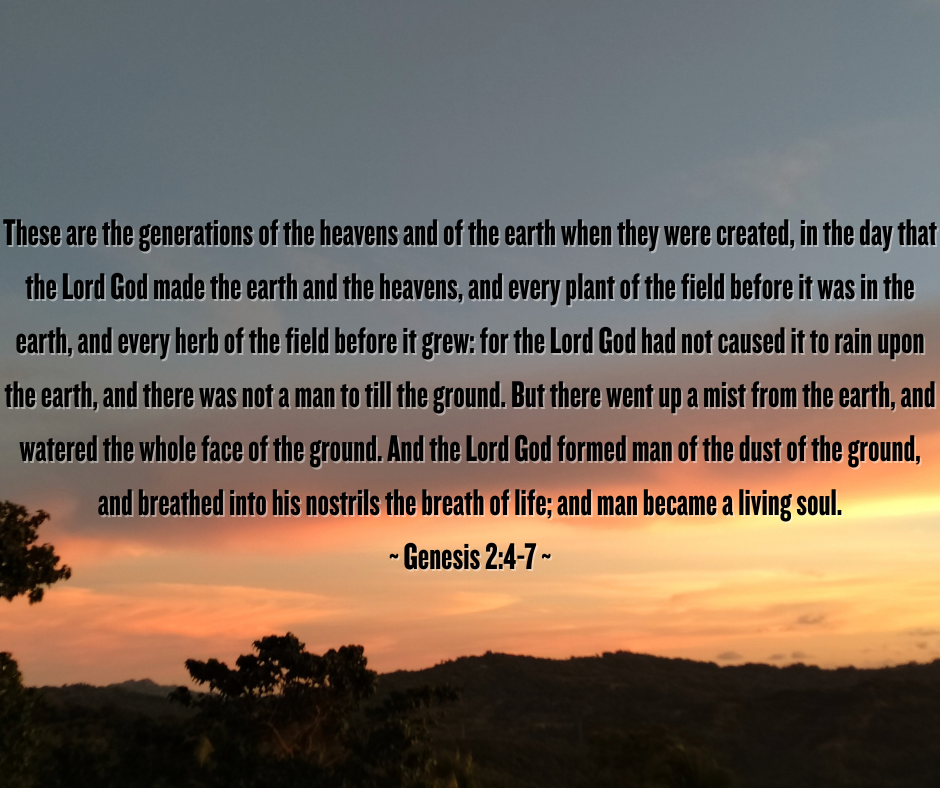
Matthew Henry, reflecting on Genesis 2:4-7, wrote: “The earth did not bring forth its fruits of itself: this was done by Almighty power. Thus grace in the soul grows not of itself in nature’s soil, but is the work of God” (1997, p. 3).
Henry’s insight powerfully captures a central biblical truth: just as physical life and fruitfulness require the direct intervention of God, so also spiritual life and growth come not from man’s natural abilities or desires, but solely from the sovereign grace of God. Without God’s rain, the earth remains barren; and without God’s Spirit, the soul remains dead.
The Work of God in Creation and Salvation
The creation narrative emphasizes that God alone is the Author of life. Man’s body was formed from the dust, shaped by divine hands, but it remained lifeless until God breathed into it the “breath of life.” At that moment, man became more than dust—he became a living soul.
This act prefigures the spiritual reality of regeneration. The dust represents our humble origin, and the breath of life reveals our utter dependence on God for both physical and spiritual existence. As Henry noted, “The soul was not made of the earth, as the body: pity then that it should cleave to the earth, and mind earthly things” (1997, p. 3). The soul, coming from God Himself, was made for higher things—for communion with its Creator.
Yet in the Fall, man turned away from the Giver of life and chose the path of death, cleaving to the earth rather than to God. Since then, every descendant of Adam is born physically alive but spiritually dead. As Paul writes in Ephesians 2:1, “And you hath he quickened, who were dead in trespasses and sins.”
The Gospel in Genesis
Genesis 2:7 contains within it the seeds of the Gospel. Man is not merely a physical being; he is a spiritual creation made in the image of God. However, that image has been marred by sin, and man’s soul, intended for fellowship with God, now longs in vain for peace while clinging to the dust of this world.
But God, in His mercy, has not left us in this state. The same God who breathed life into Adam is the same God who breathes new life into the spiritually dead through Jesus Christ. In 1 Corinthians 15:45, Paul declares, “The first man Adam was made a living soul; the last Adam was made a quickening spirit.” Jesus, the second and greater Adam, came to restore what was lost and to impart spiritual life to those who are dead in sin.
The Lord Jesus declared in John 3:5–7: “Verily, verily, I say unto thee, Except a man be born of water and of the Spirit, he cannot enter into the kingdom of God… Marvel not that I said unto thee, Ye must be born again.”
Just as Adam’s body could not come to life without the breath of God, no sinner can be saved apart from the regenerating work of the Holy Spirit. Salvation is not self-wrought; it is God-wrought. It is not the improvement of nature, but the creation of new life. As Titus 3:5 reminds us: “Not by works of righteousness which we have done, but according to his mercy he saved us, by the washing of regeneration, and renewing of the Holy Ghost.”
A Warning and a Call
Henry warns: “To God we must shortly give an account, how we have employed these souls; and if it be found that we have lost them, though it were to gain the world, we are undone for ever! Fools despise their own souls, by caring for their bodies before their souls” (Henry, 1997, p. 3).
This is a sobering truth. The soul is eternal. To neglect it—to trade it for temporary pleasures or worldly success—is the height of folly. As Jesus said in Matthew 16:26, “For what is a man profited, if he shall gain the whole world, and lose his own soul?”
In light of this, the Gospel calls every man and woman to turn from the dust—to repent of sin, to forsake earthly idols, and to receive the breath of life that Christ alone can give. The One who formed man from dust now offers to re-form sinners into new creations.
“Therefore if any man be in Christ, he is a new creature: old things are passed away; behold, all things are become new” (2 Corinthians 5:17).
Conclusion
Genesis 2:4–7 not only tells us where we came from, but also where we are meant to go. Created from dust, man was given a soul by the breath of God. Though sin has brought death, the Gospel offers life—life eternal through the breath of Christ, the quickening Spirit.
Let us not cling to the dust but lift our eyes to heaven. For the same God who formed man in the beginning now invites us into newness of life through His Son. May we be wise and care for our souls, treasuring the breath of life, and glorifying the God who made us, redeemed us, and promises to raise us to glory.