
The modern world’s ecosystems depend on predator-prey relationships to maintain balance. If, as the Bible teaches, the original creation had no death or carnivory, how did the food chain work? Furthermore, if death only entered the world after Adam’s sin, why does fossil evidence suggest animal suffering before human history?
How Did the Pre-Fall Ecosystem Function Without Carnivory?
A Supernatural, Perfectly Sustained World
The pre-Fall world was fundamentally different from today’s fallen creation. According to Genesis 1:31, everything God made was “very good.” This suggests a world without suffering, competition, or predation.
- Romans 8:20-22 teaches that creation was subjected to vanity (futility, decay) because of sin. Before this corruption, nature did not operate under the same biological constraints as it does today.
- God’s supernatural provision could have sustained all creatures without the need for death. Just as God miraculously sustained Israel with manna (Exodus 16) and multiplied food through Christ (Matthew 14:13-21), He could have provided for animals in a pre-Fall world.
A Universal Plant-Based Diet
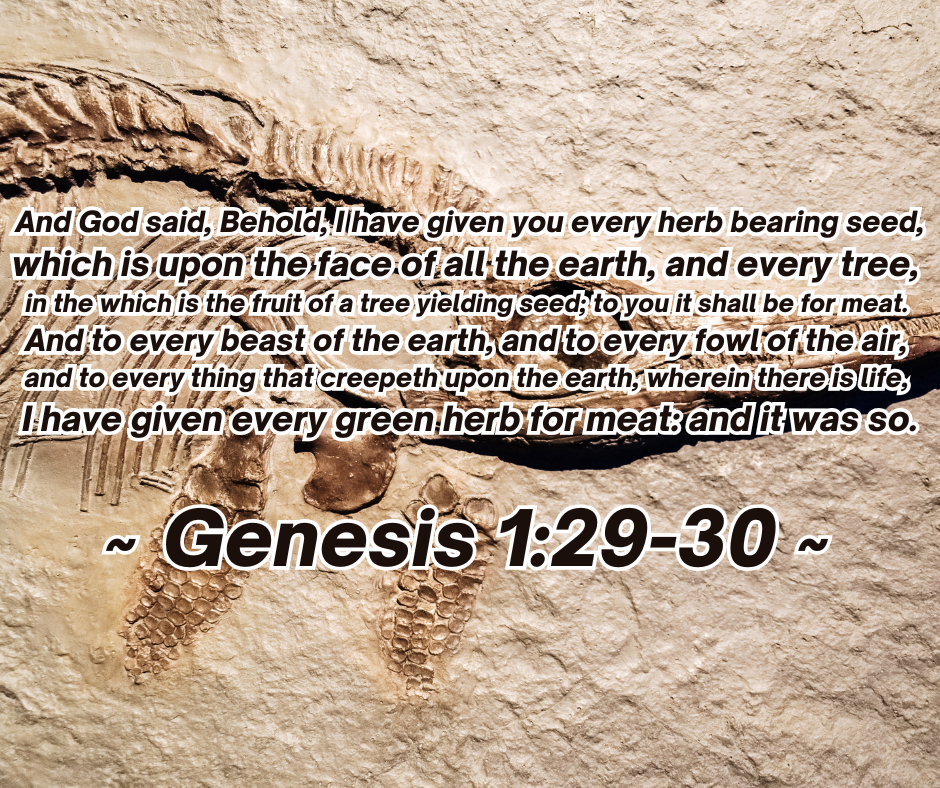
God explicitly states in Genesis 1:29-30 that both humans and animals were given plants for food. This strongly suggests that all creatures, including those that are now carnivorous, originally consumed plants. Even today, some animals we associate with predation can survive on plant-based diets. For example, some lions and bears have been observed thriving on vegetarian diets, demonstrating that their biology does not require meat.
Absence of Competition and Overpopulation
In today’s world, predation helps regulate animal populations, preventing overpopulation and resource depletion. However, in the pre-Fall world, alternative mechanisms could have maintained ecological balance:
- Perfect Reproductive Regulation: God, in His wisdom, could have designed animal reproduction to match available resources without the need for death.
- Slower Aging or Different Biological Functions: Without decay or disease, animals may not have aged in the same way they do today.
- Unlimited Plant Growth: The Earth’s original conditions may have allowed continuous and abundant plant growth, eliminating food scarcity.
Isaiah’s Prophecy and the Restored Creation
Isaiah 11:6-9 and Isaiah 65:25 prophesy a future where predators and prey coexist peacefully: “The wolf also shall dwell with the lamb, and the leopard shall lie down with the kid; and the calf and the young lion and the fatling together; and a little child shall lead them” (Isaiah 11:6).
This vision of restored harmony in the millennial kingdom suggests that the original world functioned similarly, without predation or violence.
Did Animal Death and Suffering Exist Before the Fall?
The Biblical Teaching on Death’s Origin
The Bible consistently teaches that death entered the world through sin:
- Romans 5:12 – “Wherefore, as by one man sin entered into the world, and death by sin; and so death passed upon all men, for that all have sinned.”
- Genesis 3:19 – “For dust thou art, and unto dust shalt thou return.”
- 1 Corinthians 15:21-22 – “For since by man came death, by man came also the resurrection of the dead.”
These passages make it clear that death was not part of the original creation but came as a direct result of sin.
Young Earth View: The Flood and Fossilization
From a young-earth creationist perspective, fossils do not prove pre-Fall death because they are better explained by Noah’s Flood (Genesis 6-9):
- The global Flood rapidly buried animals under layers of sediment, creating the fossils we see today.
- Many fossilized creatures show evidence of rapid burial (e.g., fish caught mid-swallow), which supports a catastrophic flood rather than slow, gradual processes.
- Fossils do not have inherent timestamps. Secular dating methods rely on assumptions that contradict the biblical timeline.
Old Earth View: Does Romans 5:12 Refer Only to Human Death?
Some old-earth creationists argue that Romans 5:12 only refers to human death, not animal death. Their reasoning:
- The immediate context of Romans 5:12-21 focuses on human sin and redemption, leading some to believe it does not apply to animals.
- They suggest that natural animal death might have existed before Adam’s sin but was not morally or spiritually significant.
However, Romans 8:20-22 states that all creation was subjected to corruption because of sin, implying that animal suffering and death are also consequences of the Fall.
Was Pre-Fall Animal Suffering Misinterpreted?
Fossilized evidence of so-called “disease” and “predation” is often interpreted through an evolutionary lens, which assumes millions of years of death and struggle before humanity. However, these interpretations are not always definitive. What may appear to be signs of disease in fossils could instead be the result of post-mortem damage, mineralization processes, or other environmental factors during fossilization.
Additionally, sharp teeth alone do not necessarily indicate a carnivorous diet. While commonly associated with predation, sharp teeth can serve various functions, including tearing tough plant material. For example, pandas possess sharp canine teeth yet primarily consume bamboo, and fruit bats have fang-like teeth but subsist on fruit. This suggests that an animal’s original diet cannot be determined solely by tooth structure.
Conclusion: A Biblical Worldview of Creation and Death
The Bible clearly teaches that death and suffering entered the world through Adam’s sin (Romans 5:12, Genesis 3:19) and were not part of God’s original creation. Before the Fall, the world operated under a divinely sustained order, where animals coexisted in perfect harmony, free from predation, violence, or decay.
Rather than contradicting Scripture, fossil evidence aligns with the biblical narrative and can be understood through events such as Noah’s Flood, which provides a logical explanation for the rapid burial and preservation of countless organisms.
Furthermore, prophecies about the future restoration of creation (Isaiah 11:6-9, Revelation 21:4) describe a return to a world without death or suffering, reinforcing the belief that this was God’s original design in Eden.
Ultimately, a biblical worldview upholds that God created a perfect world, free from death and corruption, that sin brought devastation to creation, and that God will one day restore all things to their intended glory through Jesus Christ (Romans 8:20-21, 1 Corinthians 15:21-26).