
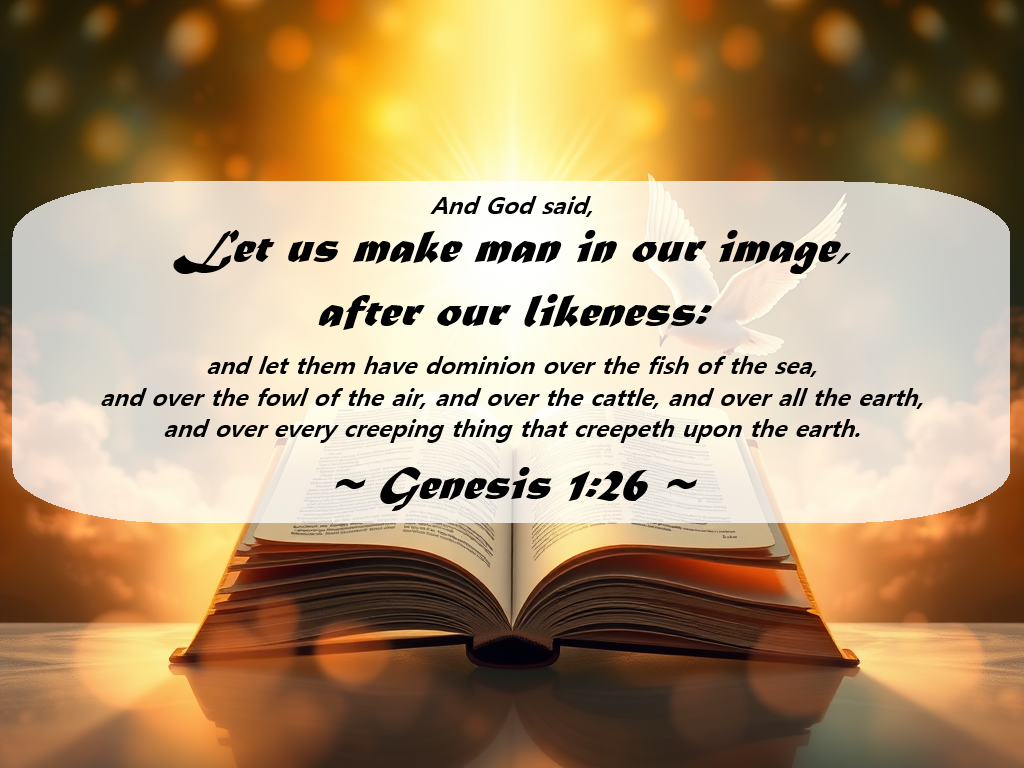
The plural pronouns used by God in Genesis 1:26—“Let us make man in our image, after our likeness”—have sparked significant theological discussion. These pronouns suggest a level of complexity within God’s being, inviting interpretations ranging from the Trinity to other possible explanations. Over the next few days, we will explore the primary interpretations, analyzing their strengths and weaknesses in light of Scripture and theological considerations.
We’ll begin with the Trinitarian interpretation, which sees the plural pronouns as an early indication of the triune nature of God: Father, Son, and Holy Spirit. The New Testament provides clarity on this concept, with passages like John 1:1-3 affirming the Son’s role in creation and Genesis 1:2 mentioning the Spirit’s presence. Proponents argue that the plural pronouns reflect an intra-divine conversation, suggesting relationality and unity within the Godhead.
Evidence of Intra-Divine Communication in the Old Testament
The Old Testament provides glimpses of what can be understood as intra-divine communication, moments that foreshadow the relational nature of the Godhead as revealed more fully in the New Testament. While the concept of the Trinity is not explicitly developed in the Old Testament, certain passages hint at distinctions within the divine unity. These passages, when viewed in light of later revelation, appear to describe conversations or interactions within the Godhead—Father, Son, and Holy Spirit. Key examples include Psalm 2:7, Isaiah 48:16, and Psalm 45:6-7.
1. Psalm 2:7 – The Father Declares the Son’s Role
Psalm 2:7 states: “I will declare the decree: the LORD hath said unto me, Thou art my Son; this day have I begotten thee.” This verse is widely interpreted in Christian theology as a prophetic reference to the relationship between God the Father and God the Son. Here, the speaker (the Son) recounts the words of the LORD (the Father), suggesting a dialogic interaction within the Godhead.
The New Testament explicitly identifies this verse as a reference to Jesus Christ, the eternal Son of God, citing it in Acts 13:33, Hebrews 1:5, and Hebrews 5:5. This declaration emphasizes the unique and distinct personhood of the Son, who is begotten, not created, affirming His eternal relationship and fellowship with the Father. By issuing this decree, the Father establishes the Son’s divine authority and pivotal role within His sovereign plan, particularly highlighting Christ’s kingship, His divine right to rule, and His central role in the redemptive mission to save humanity.
2. Isaiah 48:16 – The LORD, His Spirit, and the Speaker
Isaiah 48:16 presents a striking example of intra-divine interaction: “Come ye near unto me, hear ye this; I have not spoken in secret from the beginning; from the time that it was, there am I: and now the Lord GOD, and his Spirit, hath sent me.”
This verse compellingly highlights three distinct entities: the speaker (commonly identified as the pre-incarnate Christ or the Servant of the LORD), the Lord GOD (the Father), and His Spirit (the Holy Spirit). This triadic reference serves as a profound precursor to the Trinitarian understanding of God, emphasizing both unity and distinction within the divine nature. The speaker declares being sent by the Lord GOD and His Spirit, reflecting the “sending” motif central to the New Testament, where the Father sends the Son, and the Spirit empowers His mission (e.g., John 3:17; Luke 4:18). This verse vividly illustrates the harmonious cooperation within the Godhead in achieving divine purposes, showcasing the distinct roles of the Father as sender, the Son as the sent one, and the Spirit as the enabler of God’s redemptive plan.
3. Psalm 45:6-7 – The Anointed One and His God
Psalm 45:7 declares: “Thy throne, O God, is for ever and ever: the sceptre of thy kingdom is a right sceptre. Thou lovest righteousness, and hatest wickedness: therefore God, thy God, hath anointed thee with the oil of gladness above thy fellows.” This psalm portrays the anointed one being addressed as “God” (“Thy throne, O God, is for ever and ever”), while simultaneously acknowledging the role of “God, thy God.” This striking duality underscores the divine nature of the Son and His relational connection with the Father. The New Testament explicitly identifies Jesus Christ as the ultimate fulfillment of this psalm, revealing Him as both fully divine and the anointed Messiah (Hebrews 1:8-9). The verse beautifully captures the relational dynamic within the Godhead, where one person of the Trinity anoints another, illustrating both their unity in essence and distinction in personhood. This interaction affirms the cooperative work of the Father and Son within the divine economy of redemption.
These Old Testament passages—Psalm 2:7, Isaiah 48:16, and Psalm 45:6-7—provide profound insights into the relational nature of the Godhead. While they may have been enigmatic to their original audience, they are illuminated by the New Testament revelation of the Trinity. Together, they reveal a pattern of communication and cooperation within the Godhead, pointing to the eternal fellowship between the Father, Son, and Holy Spirit. This relational dynamic underscores the depth and complexity of God’s nature, affirming the unity and diversity within the divine essence.
New Testament Confirmation of the Trinity and the Son’s Role in Creation
The New Testament provides powerful confirmation of the Son’s involvement in creation and the harmonious relationship between the distinct persons of the Trinity.
John 1:1-3 affirms the eternal nature and active role of the Son in creation: “In the beginning was the Word, and the Word was with God, and the Word was God. The same was in the beginning with God. All things were made by him; and without him was not any thing made that was made.” This passage unmistakably identifies the Son (the Word) as both divine and the agent through whom all things came into existence, emphasizing His preeminence and creative authority.
Similarly, Colossians 1:16 elaborates on the Son’s central role in creation: “For by him were all things created, that are in heaven, and that are in earth, visible and invisible, whether they be thrones, or dominions, or principalities, or powers: all things were created by him, and for him.” This verse not only underscores the Son’s agency in creation but also His purpose as its ultimate goal—creation exists for His glory and dominion.
Matthew 3:16-17 provides one of the clearest depictions of the distinct persons of the Trinity working in perfect harmony. At Jesus’ baptism, “the heavens were opened unto him, and he saw the Spirit of God descending like a dove, and lighting upon him: And lo a voice from heaven, saying, This is my beloved Son, in whom I am well pleased.” In this moment:
- The Father speaks from heaven, affirming His love and approval of the Son.
- The Son submits to baptism, fulfilling all righteousness and inaugurating His public ministry.
- The Spirit descends upon the Son, empowering Him for His earthly mission.
This scene vividly portrays the relational unity within the Godhead, with each person—Father, Son, and Holy Spirit—engaging in a distinct role while remaining perfectly unified in purpose and essence.
These passages collectively demonstrate that the Son is not a subordinate or created being but an eternal, divine participant in creation and redemption. The baptism account reflects the perfect unity and cooperation within the Trinity, providing a model of relational harmony that defines God’s nature. Through these New Testament affirmations, we see the distinct yet unified work of the Triune God in both creation and salvation, revealing the richness and depth of God’s nature as Father, Son, and Holy Spirit.
God’s Unity and Singular Role in Creation
Genesis 1:27 shifts from the plural language of “Let us make man in our image” (Genesis 1:26) to the use of singular pronouns: “So God created man in his own image, in the image of God created he him; male and female created he them.” This deliberate use of singular pronouns underscores the unity of God as the sole Creator, despite the earlier reference to plurality.
The singular pronouns (“his,” “he”) emphasize that the creation of humanity is an act uniquely and exclusively attributable to God. This is consistent with the broader biblical testimony of God’s unity and sovereignty, as seen in Deuteronomy 6:4: “Hear, O Israel: The LORD our God is one LORD.” The singular language leaves no room for the involvement of any other being—such as angels or creation itself—in the actual act of forming humanity.
While Genesis 1:26 uses plural pronouns (“Let us make man”), suggesting a complexity within God’s nature, Genesis 1:27 transitions to singular language to affirm His oneness. This dual emphasis aligns with the Trinitarian understanding of God as one essence in three persons—Father, Son, and Holy Spirit. The plurality in Genesis 1:26 hints at intra-divine conversation, while the singular pronouns in Genesis 1:27 reinforce that God alone is Creator, reflecting both unity and distinction within the Godhead.
Affirmation of Monotheism
The use of singular pronouns in Genesis 1:27—“So God created man in his own image, in the image of God created he him; male and female created he them”—strongly counters any suggestion of polytheism. This linguistic choice underscores the fundamental biblical teaching that the one true God is the sole Creator of humanity and all things, standing in stark contrast to the polytheistic worldviews of the surrounding cultures.
The singular pronouns in Genesis 1:27 align with the consistent affirmation of monotheism throughout Scripture. Passages such as Isaiah 44:24 declare God’s exclusive role in creation: “I am the LORD that maketh all things; that stretcheth forth the heavens alone; that spreadeth abroad the earth by myself.” This verse leaves no room for the involvement of other deities or entities in the creative process. God’s solitary action in creation highlights His unrivaled sovereignty and authority.
Other Scriptures further reinforce this truth:
- Isaiah 45:5-6: “I am the LORD, and there is none else, there is no God beside me.”
- Deuteronomy 6:4: “Hear, O Israel: The LORD our God is one LORD.”
- 1 Corinthians 8:6: “But to us there is but one God, the Father, of whom are all things, and we in him; and one Lord Jesus Christ, by whom are all things, and we by him.”
In these passages, the singularity of God is not only emphasized but is positioned as a cornerstone of faith, rejecting any notion of a pantheon or multiple divine beings.
The singular pronouns in Genesis 1:27 affirm that God alone is worthy of worship and glory as the Creator. This statement serves as a direct challenge to polytheistic creation myths, which often portray creation as the outcome of collaboration, conflict, or rivalry among multiple gods. In stark contrast, the Bible declares that humanity was uniquely created in His image, underscoring the profound and personal relationship between the Creator and His creation. This truth establishes humanity’s purpose and inherent dignity, rooted in being intentionally fashioned by the one true God.
The singularity of God’s creative act also reveals His omnipotence. Unlike the gods of pagan mythologies, who are frequently depicted as limited, dependent, or embroiled in disputes, the God of the Bible requires no assistance or external force to bring the universe or humanity into existence. His act of creation is marked by unmatched sovereignty and absolute authority, showcasing not only His power but also His purposeful design in crafting a creation that reflects His own character and glory.
In the ancient Near East, cultures such as those of Egypt, Mesopotamia, and Canaan attributed creation to multiple gods, often presenting it as a chaotic process born from divine struggles or cooperative efforts. Genesis 1:27 boldly stands in opposition to these views, asserting that creation is the work of one sovereign God. This affirmation of monotheism is not merely a theological statement but also a cornerstone of Israel’s identity and covenant relationship with God. By rejecting polytheism, the text reinforces the uniqueness of the God of Israel as the sole, all-powerful Creator, who alone is worthy of worship and allegiance.
The interplay of plural and singular pronouns in Genesis 1:26-27 does not imply the existence of multiple gods but subtly points to the complexity of God’s nature—one God existing in three persons, as fully revealed in the New Testament. The plural pronouns in “Let us make man in our image” hint at a relational dynamic within the Godhead, while the singular pronouns in “So God created man in his own image” affirm the fundamental truth of monotheism. Together, these linguistic choices uphold the unity of God while allowing for the relational richness and distinct persons within the Trinity.
The shift from plural to singular pronouns in Genesis 1:26-27 is a subtle yet profound affirmation of God’s unity and singular role as Creator. It reveals a God who is both relationally complex and indivisibly one, laying the foundation for a deeper understanding of His triune nature revealed more fully in the New Testament. Through this unity, the text underscores the exclusivity and majesty of God’s work in creating humanity in His image, a foundational truth for understanding both God’s nature and humanity’s purpose.
Arguments Against a Trinitarian Interpretation
Historical and Cultural Context
Critics often argue that Moses and his audience, rooted in the cultural and theological context of the ancient Near East, would not have interpreted the plural pronouns in Genesis 1:26 (“Let us make man in our image, after our likeness”) as a reference to the Trinity. The doctrine of the Trinity—God existing as Father, Son, and Holy Spirit in one essence—was only fully revealed in the New Testament, with explicit teachings found in passages like Matthew 28:19, John 1:1-3, and 2 Corinthians 13:14.
For Moses’ audience, steeped in a monotheistic framework and accustomed to combating the polytheism of surrounding cultures, the plural pronouns might have been seen as a linguistic or theological anomaly rather than a clear reference to a triune God. Their understanding of God would have centered on His singularity, as emphasized in foundational texts like Deuteronomy 6:4: “Hear, O Israel: The LORD our God is one LORD.”
Caution in Theological Interpretation
Some scholars urge caution in interpreting the plural pronouns in Genesis 1:26 as definitive proof of the Trinity without explicit confirmation from the New Testament that this verse directly refers to the triune nature of God. While the plural phrasing (“Let us make man in our image”) may hint at relational complexity within God’s nature, it is not an unambiguous Trinitarian statement. Instead, the doctrine of the Trinity unfolds progressively throughout Scripture, reaching its clearest articulation in the New Testament.
The New Testament provides the fullest revelation of the distinct persons of the Godhead acting in perfect unity. For example, at the baptism of Jesus (Matthew 3:16-17), the Father speaks from heaven, the Son is baptized, and the Spirit descends as a dove, vividly portraying the relational dynamic within the Trinity. Similarly, in the Great Commission (Matthew 28:19), Jesus commands His disciples to baptize “in the name of the Father, and of the Son, and of the Holy Ghost,” affirming the triune identity of God. These passages clarify and confirm the relational complexity that is subtly suggested in Genesis 1:26, completing the biblical revelation of God’s triune nature.
Balanced Perspective
- Hints and Foreshadowing: While not a full doctrinal statement, the plural pronouns in Genesis 1:26 can be understood as a subtle hint of God’s triune nature, a reality that would later be clarified through the incarnation of Christ and the outpouring of the Holy Spirit. Passages such as John 1:1-3, which tie the Son to the act of creation, and Genesis 1:2, which mentions the Spirit of God, provide New Testament corroboration for viewing the creation account through a Trinitarian lens.
- Progressive Revelation: Scripture progressively reveals the nature of God, moving from a foundational monotheism in the Old Testament to the fuller understanding of the Trinity in the New Testament. This gradual unfolding underscores the wisdom of divine revelation, meeting people where they are while laying the groundwork for deeper truths.
- Avoiding Overreach: While the plural pronouns offer compelling theological implications, caution is needed to avoid imposing later doctrinal clarity onto an earlier text without clear textual or contextual support. Recognizing this helps maintain the integrity of biblical interpretation and respects the historical understanding of the original audience.
The plural pronouns in Genesis 1:26 may not have been fully understood by Moses or his audience as a reference to the Trinity, but they provide a fascinating glimpse into the relational nature of God, a concept that would be fully unveiled in the New Testament. Scholars rightly urge caution in using this verse as standalone proof of the Trinity, emphasizing the importance of interpreting it in light of the entire biblical narrative, where the relational complexity of the Godhead is revealed with clarity and depth.