
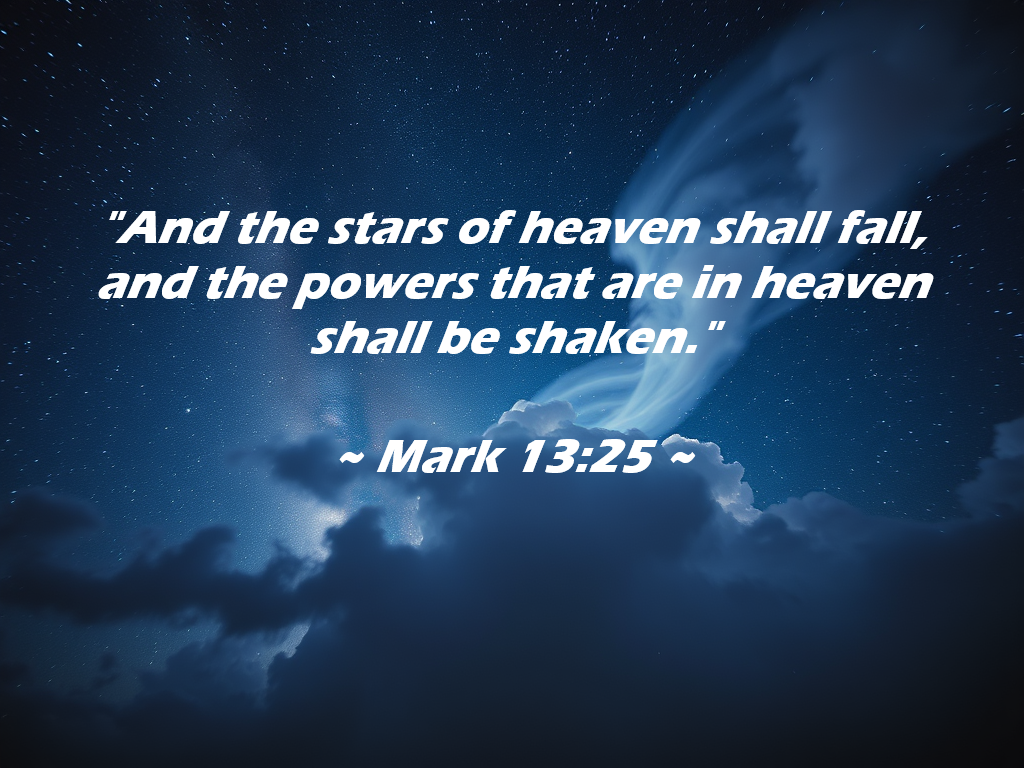
The nature of the firmament described in Genesis 1 has sparked a long-standing debate: is it a solid dome or a symbolic expanse? The discussion is often influenced by various cultural and linguistic contexts, but one of the most intriguing pieces of evidence comes from the New Testament, specifically Mark 13:25:
“And the stars of heaven shall fall, and the powers that are in heaven shall be shaken.”
This verse is part of Jesus’ prophecy about the end times and raises important questions about the structure of the heavens, as it implies a cosmic disturbance. If the firmament were a solid, unyielding dome, how should we understand the imagery of the heavens shaking and stars falling? Let’s explore this question in more depth, focusing on what Mark 13:25 reveals about the biblical concept of the firmament.
The Firmament as a Solid Dome: A Problematic Interpretation
Those who argue for the firmament as a solid dome often base their view on the Hebrew word raqia, which implies something spread out, like beaten metal. The idea of a solid sky or barrier holding back the “waters above” aligns with ancient Near Eastern cosmology. However, this interpretation faces significant challenges when we consider the language used in Mark 13:25.
- Shaking of the Powers in Heaven
In Mark 13:25, Jesus describes a cataclysmic event where the very “powers in heaven” are shaken. If the heavens were a solid, immovable structure, this shaking would be difficult to conceptualize. A solid dome would imply stability and permanence. The imagery of shaking instead suggests a dynamic, fluid sky, one that can be disrupted and disturbed by divine intervention. This challenges the notion of a fixed, unchanging firmament. - The Fall of the Stars
The verse also states that “the stars of heaven shall fall.” A literal interpretation of a solid dome would imply that the stars are fixed points embedded within the firmament. If so, the “falling” of stars would require the breaking or shattering of the firmament itself. Yet the text does not describe a rupture of a physical barrier but rather a cosmic upheaval, where stars, understood as celestial bodies or lights, lose their place in the heavens. This suggests a vision of the sky as an open expanse rather than a solid structure. - The Powers in Heaven: Celestial Beings or Cosmic Order?
Another layer of interpretation comes from understanding the phrase “the powers that are in heaven.” In biblical language, “powers” often refers not just to physical structures but to spiritual beings or forces that govern the cosmos (e.g., angels or principalities). The shaking of these powers may indicate a disruption in the cosmic order or the spiritual hierarchy of the heavens, rather than a literal shaking of a solid dome. This interpretation aligns with passages like Ephesians 6:12, which mentions “spiritual wickedness in high places,” suggesting a connection to spiritual entities rather than physical objects.
A Dynamic View of the Heavens
Mark 13:25 provides a vivid image of the end times that is best understood within a framework where the heavens are dynamic, not static. The idea of the heavens shaking and stars falling is consistent with a cosmology where the sky is an expansive space filled with moving bodies. This view is supported by other biblical texts that describe the heavens in fluid, flexible terms:
- Isaiah 34:4 states, “And all the host of heaven shall be dissolved, and the heavens shall be rolled together as a scroll.” Here, the heavens are likened to a scroll, something that can be rolled up, indicating flexibility.
- Revelation 6:13 speaks of “the stars of heaven” falling “unto the earth, even as a fig tree casteth her untimely figs, when she is shaken of a mighty wind.” The imagery is that of a violent wind shaking a tree, again pointing to a sky that is expansive and able to move, rather than a fixed, solid structure.
Conclusion: The Heavens as an Expanse, Not a Dome
Mark 13:25 serves as a strong indicator against the interpretation of the firmament as a solid dome. The language of the stars falling and the powers in heaven being shaken suggests a dynamic, fluid view of the cosmos. It aligns better with an understanding of the firmament as an expanse — the sky or the heavens as a vast, open space that God created and sustains.
This interpretation fits with the broader biblical narrative, where the heavens are portrayed as God’s majestic handiwork, filled with celestial bodies that can move and respond to His will. It also resonates with the prophetic and apocalyptic imagery in Scripture, which often describes cosmic disturbances as part of God’s final judgment. Thus, the most reasonable conclusion, taking Mark 13:25 into account, is that the firmament is not a rigid dome but a flexible, expansive realm that declares the glory of God and serves as a stage for His ultimate purposes.