
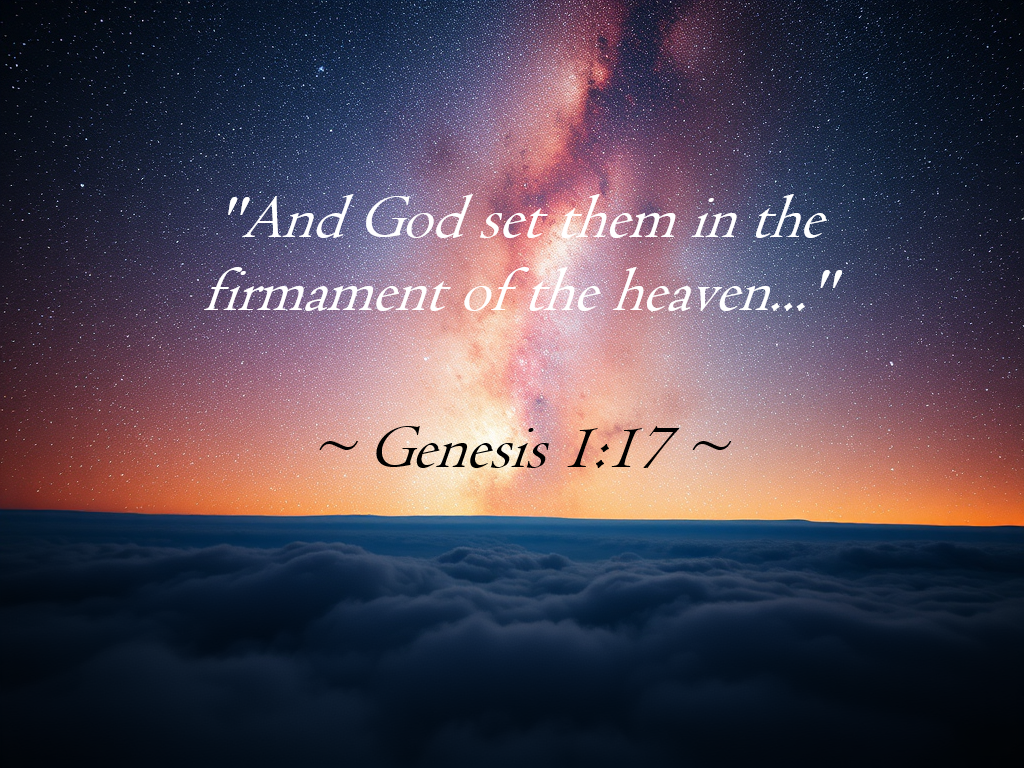
In Genesis 1, as part of the detailed account of God’s creation, an important aspect of the narrative is the establishment of the heavens. The term “firmament” plays a central role in this description, and understanding its significance deepens our appreciation of God’s design. The concept of the firmament reveals God’s wisdom and order in creation, pointing to both the physical and spiritual realities He has structured for His glory.
In Genesis 1:6-8, we first encounter the firmament when God separates the waters and establishes an “expanse” that He calls “Heaven.” At this point in the creation account, the firmament refers to the atmosphere—the sky and air above us, where the birds will later fly, as we see in verse 20. This “first heaven” surrounds the earth, the immediate environment we live in, the domain where clouds gather and birds soar. It’s the space that sustains life through the perfect provision of air, moisture, and other conditions essential for God’s creation on Earth.
However, in verse 17, we see God setting lights—the sun, moon, and stars—“in the firmament of the heaven,” signaling a shift in the meaning of the firmament from the earth’s atmosphere to something beyond. This second mention of the firmament refers not to the sky above Earth, but to the vast expanse of space, stretching far beyond our immediate surroundings. The immense universe, with its stars and celestial bodies, reveals God’s unfathomable greatness and creativity. This “second heaven” points to the immensity of God’s creation, a cosmic firmament that we now know stretches across unimaginable distances.
For ancient readers, and even Moses, this distinction between the two firmaments may not have been fully understood, as they lacked the scientific knowledge of our modern era. However, the Holy Spirit revealed to Moses what was necessary to convey the order and purpose of God’s creation. What Moses called the “firmament” is now recognized as both the sky (the first heaven) and the expanse of space (the second heaven).
Yet, there is more to this picture, as the Bible reveals not only the physical creation but also the existence of a spiritual realm. In 2 Corinthians 12:2, the Apostle Paul speaks of being “caught up to the third heaven,” which he further describes as “paradise” in verse 4. This third heaven is not part of the created universe but exists beyond it, as the eternal dwelling place of God. It is where God’s holy temple and throne are established (Psalm 11:4). This is the divine realm, where God’s presence is fully realized, and from where He reigns in glory and majesty.
Thus, we see three distinct heavens described in Scripture: the first heaven, which is the expanse of the earth’s atmosphere; the second heaven, which is the great expanse of outer space; and the third heaven, where God Himself resides in His holy temple. Each of these heavens reflects a different aspect of God’s creation and dominion. The first heaven sustains earthly life; the second heaven displays God’s grandeur through the vastness of space; and the third heaven is the spiritual realm where God reigns in perfect holiness.
As Christians, we affirm the inerrancy of Scripture and recognize that God’s Word transcends human knowledge. While the understanding of the physical universe has grown through scientific discovery, the ultimate truths about creation, God’s sovereignty, and the structure of the heavens have been revealed to us through the Bible. The distinctions between the firmaments point not only to the physical realities we can observe but also to the spiritual reality of God’s eternal kingdom.
The firmament in Genesis 1 provides a glimpse into both the physical and spiritual worlds God created. As we ponder the heavens—the sky above, the stars beyond, and the dwelling place of God Himself—we are reminded of the majesty of our Creator, whose power and wisdom are far beyond human comprehension. The heavens declare the glory of God (Psalm 19:1), and each layer of this heavenly hierarchy reveals a deeper understanding of His eternal plan.