
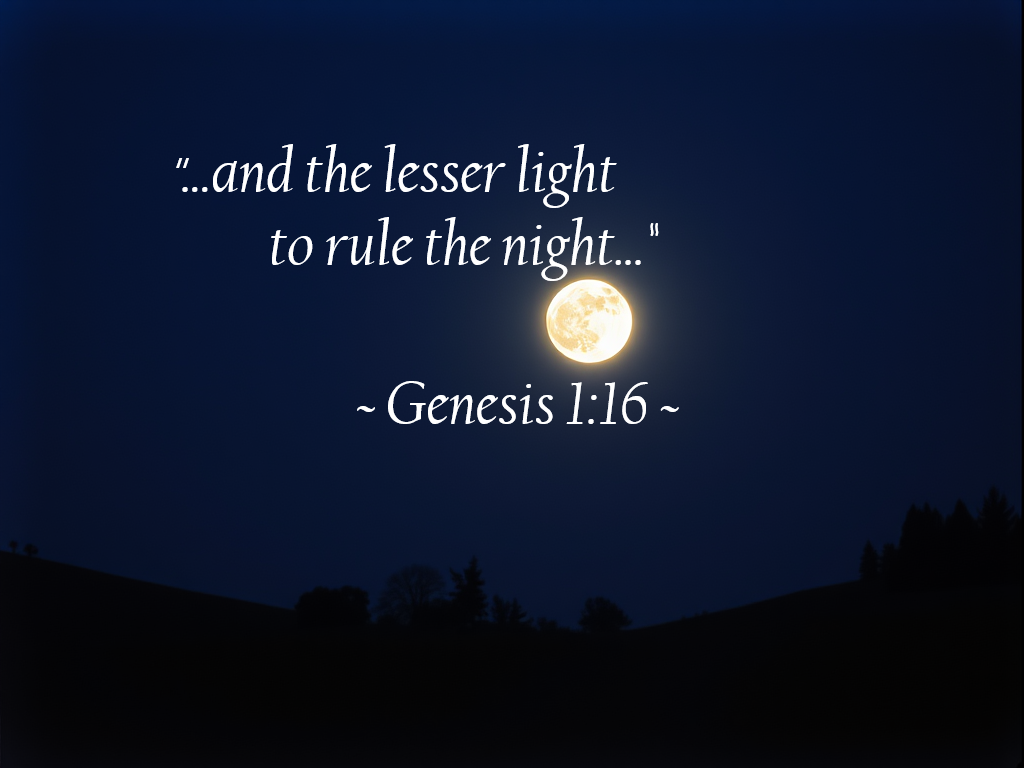
In Genesis 1:16, Scripture states, “God made two great lights; the greater light to rule the day, and the lesser light to rule the night.” Critics often question whether this passage suggests that the moon itself is a source of light, given that we know today it merely reflects the sun’s light. However, a careful reading of the passage reveals that the Bible is employing phenomenological language, describing the natural world as it appears from an earthly perspective. This does not undermine the truth of the Bible but rather affirms its ability to speak to all generations, regardless of scientific understanding.
Phenomenological Language in the Bible
The use of phenomenological language—describing events as they appear to human observation—is not uncommon in Scripture. For example, terms like “sunrise” and “sunset” are still widely used today, even though we understand scientifically that the sun doesn’t actually move in relation to the earth. These terms reflect how humans experience the world, and they remain valid even in light of modern astronomy. In the same way, the description of the moon as a “great light” in Genesis 1:16 is simply an account of how the moon appears to us here on Earth.
The Moon’s Role in God’s Creation
Genesis 1:17 further clarifies the moon’s purpose: “to give light upon the earth.” While the moon does not generate light, it reflects the sun’s light to provide illumination during the night. From the viewpoint of someone standing on Earth, the moon is indeed a “lesser light” that governs the night, fulfilling its God-given role in creation. This does not contradict scientific observations but complements them by explaining the function of the moon in the divine order.
The Bible and Scientific Observation
Some critics may argue that this passage suggests a pre-scientific misunderstanding of the cosmos. However, it’s important to recognize that the Bible was written for all people in all times, and it uses language that is accessible to human experience. The Bible’s purpose is not to provide a scientific manual but to reveal God’s plan for His creation, including the moon’s role in the beauty and balance of the night sky. As Christians, we affirm that all of nature declares the glory of God (Psalm 19:1), and that includes the moon, which reflects His creative power.
A Matter of Perspective
Just as we still speak of the sun “rising” and “setting,” even in an age of advanced science, so too does Genesis describe the moon as a “great light” based on how it appears to us on Earth. The Bible’s phenomenological perspective is a reminder that God meets us where we are. He communicates truth to us in ways that we can understand, even as our scientific knowledge grows.
Therefore, the Bible’s description of the moon as a “great light” on the fourth day of creation is not a scientific error, but a demonstration of how God speaks to human beings in the context of their everyday experience. The moon, though not a generator of light, fulfills its role as the “lesser light” by reflecting the sun’s light and illuminating the night. This passage invites us to marvel at God’s creation and trust in His Word, which remains true and relevant across all generations. We can rest in the assurance that the Bible, while not a scientific textbook, speaks with authority about the purpose and design of the cosmos, pointing us to the Creator Himself.