
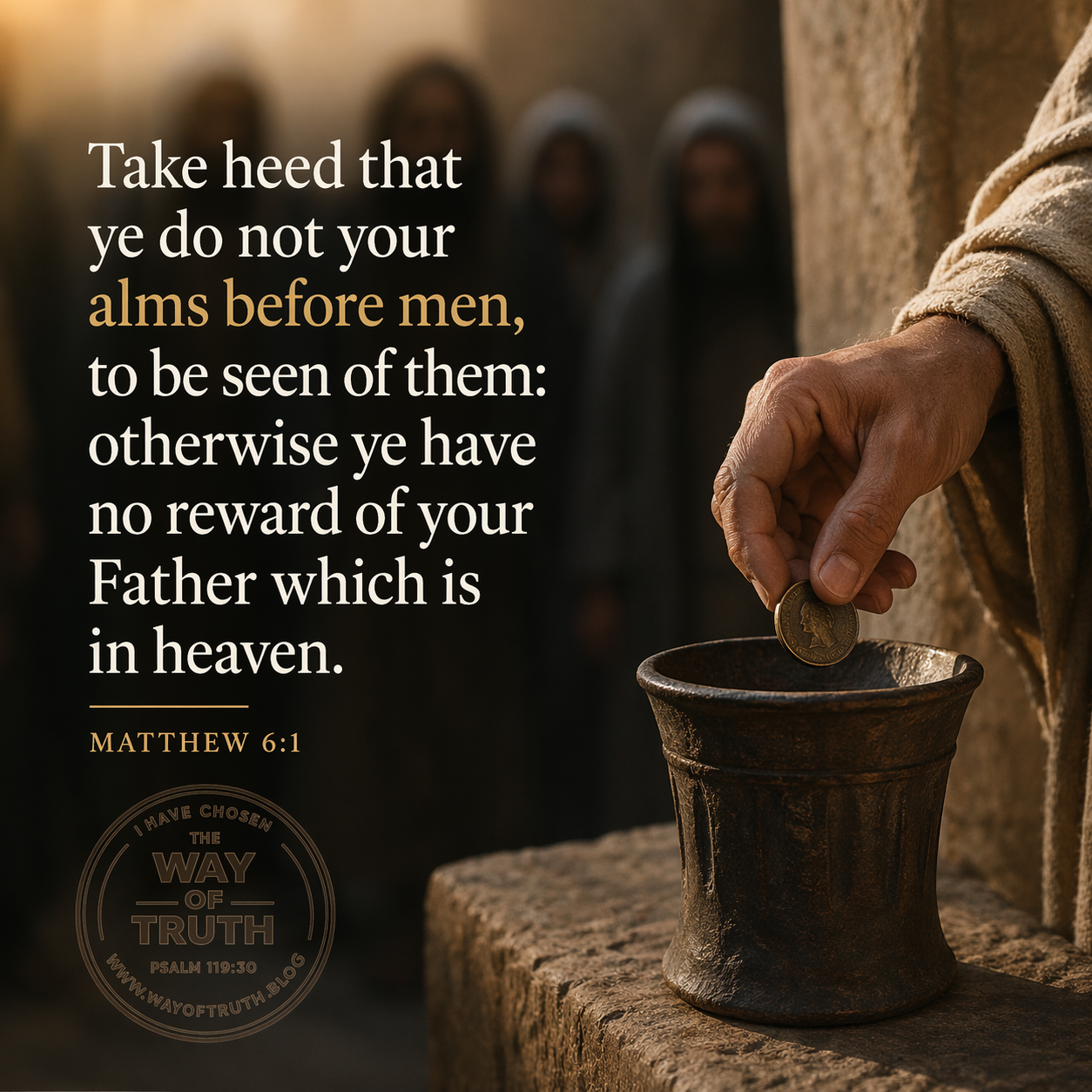
Matthew 6:1 opens a new section of the Sermon on the Mount, and it does so with a caution rather than a command. Jesus doesn’t begin by telling us what to do, but how to guard our hearts while doing it. That’s telling. The issue isn’t merely outward behavior, but inward intention.
“Take heed” carries the sense of active vigilance. This isn’t a passive warning. It assumes that even sincere believers are prone to drift into subtle hypocrisy. The danger isn’t abandoning righteousness altogether but performing it for the wrong audience.
This verse builds directly on what comes before. In Matthew 5, Jesus has just described a righteousness that surpasses the scribes and Pharisees. He has shown that true obedience flows from the heart, not just external compliance. Now, in Matthew 6, He addresses a new distortion: doing the right things for the wrong reasons.
Notice that Jesus speaks of “your alms,” referring specifically to acts of giving, but by extension including all visible expressions of righteousness such as prayer and fasting, which He will address later in the chapter. These are good and commanded practices. The problem isn’t the act but the motive: “to be seen of them.”
That phrase cuts straight to the issue. It’s possible to do something genuinely good while secretly craving recognition. And when that craving becomes the driving force, the act itself is hollowed out. It may impress others, but it doesn’t please God.
Jesus isn’t condemning all public acts of righteousness. Earlier, in Matthew 5:16, He said, “Let your light so shine before men.” The difference lies in the purpose. Are we seeking to glorify God, or to elevate ourselves?
The consequence is sobering: “otherwise ye have no reward of your Father which is in heaven.” That doesn’t mean God overlooks the act entirely, but that the reward has already been received in the form of human approval. There’s nothing more to give.
This exposes a deeper truth about God’s nature. He’s not merely concerned with what we do, but why we do it. He sees beyond appearances and weighs the heart. That alone sets biblical teaching apart from many worldviews that emphasize outward performance over inward transformation.
There have been distortions of this teaching. Some have concluded that all public expressions of faith are wrong, retreating into a kind of hidden spirituality that avoids any visible witness. But that misses the point. Jesus isn’t calling us to invisibility but to sincerity.
Others, particularly in more performance-driven religious systems, have emphasized visible acts as a means of earning merit or status. This verse decidedly dismantles that idea. If the motive is self-exaltation, the act loses its spiritual value, no matter how impressive it appears.
In a culture that thrives on visibility, recognition, and curated image, this teaching lands with surprising force. It calls us to examine not just what we do, but who we are seeking to please.
Living for an Audience of One
There’s something almost unsettling about this verse if we let it sit with us long enough. It quietly asks a question we don’t always want to answer: Why am I really doing this?
It’s easy to assume that as long as we’re doing something good, we’re on solid ground. Giving generously, serving faithfully, and speaking kindly: those are all commendable things. But Jesus gently pulls back the curtain and says, “Let’s talk about your heart for a moment.”
And that’s where it gets personal.
Most of us don’t wake up thinking, Today I’m going to impress people with my spirituality. It’s subtler than that. It might look like hoping someone notices our generosity. Or feeling a quiet sense of disappointment when no one does. Or even structuring our good works in a way that ensures they’ll be seen.
This isn’t about condemning ourselves; it’s about becoming aware. Jesus isn’t trying to discourage righteousness. He’s protecting it. Because once our motivation shifts toward human approval, something fragile gets lost. The joy of giving quietly. The freedom of serving without needing recognition. The peace of knowing that God sees, even when no one else does.
There’s a kind of spiritual rest that comes from living for an audience of One.
This has real implications for the life of the Church. When believers serve primarily for recognition, comparison and competition tend to follow. But when service flows from a sincere desire to honor God, unity grows naturally. People become less concerned with who gets credit and more focused on the shared mission of glorifying Christ.
It also shapes our witness. The world isn’t blind to hypocrisy. In fact, it often expects it. But quiet, consistent faithfulness—especially when it goes unnoticed—has a way of speaking loudly. It reflects something different that’s rooted in genuine transformation rather than performance.
It’s striking how easily we can drift in this direction without even realizing it. It’s almost as if the human heart has a built-in spotlight that keeps trying to turn itself on. We don’t have to install it; it came preloaded. The challenge is learning, by God’s grace, to switch it off.
Practically, this might mean doing certain acts of kindness without mentioning them. Giving in ways that are intentionally private. Serving where recognition is unlikely. Not as a rule, but as a way of training the heart to value God’s approval above all else.
Ultimately, this verse calls us back to something simple but profound: God sees. He sees the hidden act, the quiet sacrifice, the unseen obedience. And His reward isn’t fleeting or shallow. It’s rooted in His perfect knowledge and His gracious delight in His people.
So, the question becomes less about visibility and more about faithfulness. Not Who noticed? but Did this honor the Lord?
And that shift changes everything.
If No One Else Sees, God Does
Maybe you’ve read this and realized something uncomfortable. Not just that your actions haven’t always been perfect, but that even your good actions haven’t always come from the right place.
That’s not a small problem. It points to something deeper in all of us.
If we’re honest, we don’t just struggle to do what’s right. We struggle to want what’s right for the right reasons. Even our best moments can be mixed with pride, self-interest, or a desire for approval. Scripture calls that sin, not just in what we do, but in who we are.
And the reality is, God sees all of it. Not just the visible parts of your life, but the hidden motives too. Nothing is overlooked. That can feel overwhelming, even discouraging.
But this is exactly where the good news of the gospel meets us.
God didn’t leave us to fix ourselves or purify our own motives. He sent His Son, Jesus Christ, who lived with perfect sincerity and obedience. Every act He did was done for the glory of His Father. No mixed motives. No hidden pride. Perfect righteousness.
Then He went to the cross, not for His own sin, but for ours. He took the penalty that we deserve, bearing the full weight of sin’s judgment. And He rose again, victorious over sin and death.
Because of that, forgiveness isn’t based on how pure your motives have been. It’s based on what Christ has already done.
If you’ve never trusted in Him, you can come to Him now. Not pretending to be perfect but honestly acknowledging your need. Turning from sin and placing your faith in Jesus Christ alone.
And here’s the beautiful part. When you do, God doesn’t just forgive you. He begins to change you. Slowly, steadily, He reshapes your heart so that you begin to desire His glory more than your own.
If that’s where you are today, don’t wait. Come to Christ. Trust Him. And begin a new life lived not for the approval of others, but for the glory of the One who sees, knows, saves, and rewards.
Reflection and Response
- In what areas of your life are you most tempted to seek recognition or approval from others for doing good?
- How does remembering that “your Father… sees in secret” reshape your motivation for serving and giving?
- Are there specific acts of obedience you can intentionally do in private as an act of worship to God?
- How can you encourage a culture of sincerity and humility within your church or community?
- In what ways does the gospel free you from the need to prove yourself before others?