
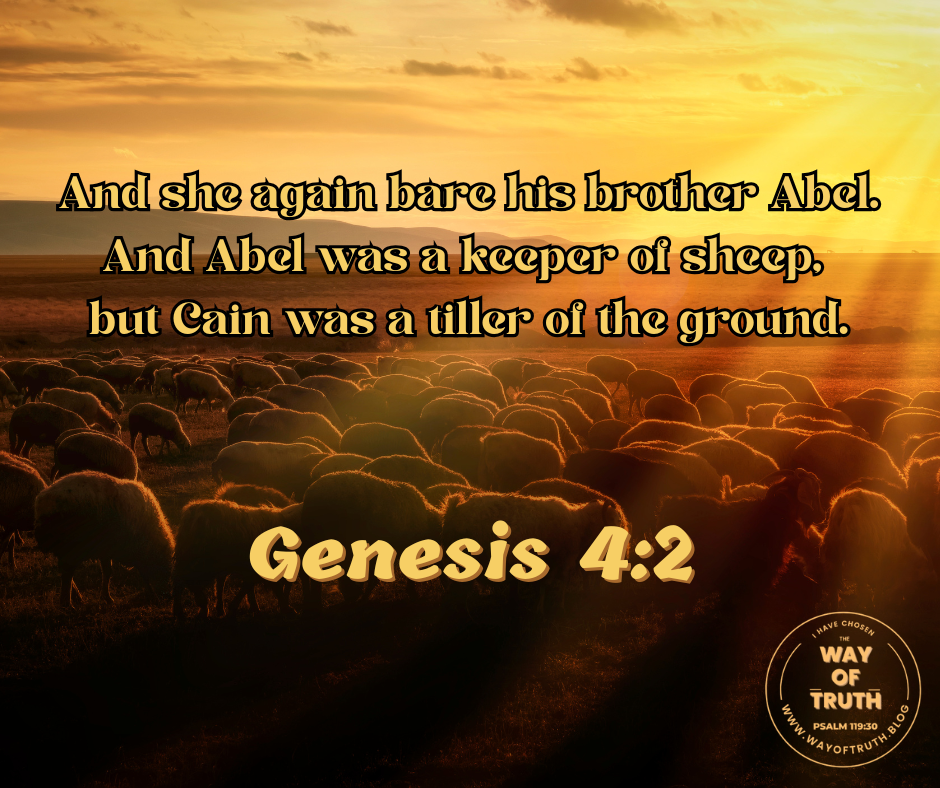
“And she again bare his brother Abel. And Abel was a keeper of sheep, but Cain was a tiller of the ground” (Genesis 4:2).
Genesis 4:2 moves us further into humanity’s life beyond Eden, introducing Abel, born into a world already marked by sin, loss, and divine judgment. Scripture presents his arrival quietly: “And she again bare his brother Abel.” The simplicity is intentional. Abel’s very name, meaning “vapor” or “breath,” foreshadows the brevity of his earthly life. Yet his quiet introduction stands in contrast to the enduring testimony of his faith, for the New Testament tells us, “he being dead yet speaketh” (Hebrews 11:4). Even in this short verse, Moses signals that the story of Cain and Abel will not be defined by their occupations alone, but by the condition of their hearts before God.
Abel is identified as “a keeper of sheep,” a vocation requiring attentiveness, sacrifice, and personal involvement with the flock. Farming and shepherding are both honored labors in Scripture, but here Abel’s work becomes the context for the offering he will later bring to the Lord. His calling reflects the dignity of work even in a cursed world. Though Adam and Eve’s sin has brought toil, labor remains a divine assignment. Abel’s shepherding anticipates biblical themes that will unfold through Abraham, Moses, David, and ultimately Christ, the Good Shepherd. His work—simple though it may seem—is a God-ordained avenue through which genuine worship will be expressed.
Cain’s vocation follows: he was “a tiller of the ground.” Farming, far from being a lesser calling, was Adam’s original task in God’s garden. Yet after the fall, the ground is cursed, and Cain inherits this frustration. Moses includes this detail to prepare the reader for how the earth will later open to receive Abel’s blood (Genesis 4:11). Still, Cain’s work itself is good and honorable. Scripture never hints that God prefers shepherds over farmers; rather, the narrative emphasizes that vocation does not determine righteousness. The heart does. The stage is set: two brothers, two callings, one God who looks not on the outward act but on the inward posture of worship.
The contrast between these brothers is therefore not found in their labor but in their spiritual lives. Genesis 4:2 quietly lays the foundation for a dramatic lesson: God is not impressed by the type of offering we bring if the heart behind it is corrupt. Abel will bring an offering “by faith” (Hebrews 11:4), and God will regard it. Cain will bring an offering without faith, and God will not regard it. Their vocations become the vessel through which the deeper truth emerges: worship is not first about material substance but about moral and spiritual sincerity. God evaluates worshipers before He evaluates worship.
For believers today, Genesis 4:2 offers a powerful reminder that God dignifies ordinary work. Shepherding and farming reflect the full spectrum of human labor: quiet, repetitive, unseen tasks performed under the gaze of God. The verse invites us to offer our daily responsibilities as acts of worship. Whether leading, teaching, parenting, serving, or laboring with our hands, we honor God when our hearts are surrendered to Him. Abel’s faith-filled work points us to the truth that excellence in vocation begins with devotion in the heart. Cain’s story warns us that outward success in labor cannot compensate for inward spiritual neglect.
Ultimately, Genesis 4:2 prepares us for the gospel itself. Abel’s righteous worship points forward to the One who would offer the perfect sacrifice: Jesus Christ, the Good Shepherd, whose blood “speaketh better things than that of Abel” (Hebrews 12:24). Cain’s failed worship reveals humanity’s natural inability to approach God rightly on our own. But Christ, through His death and resurrection, restores us to true worship. He transforms our hearts, dignifies our work, and makes our lives pleasing to God. As we labor in our everyday callings, may we do so with Abel’s faith, looking to the Shepherd who laid down His life for the sheep and who alone enables our worship to be acceptable in the sight of God.