
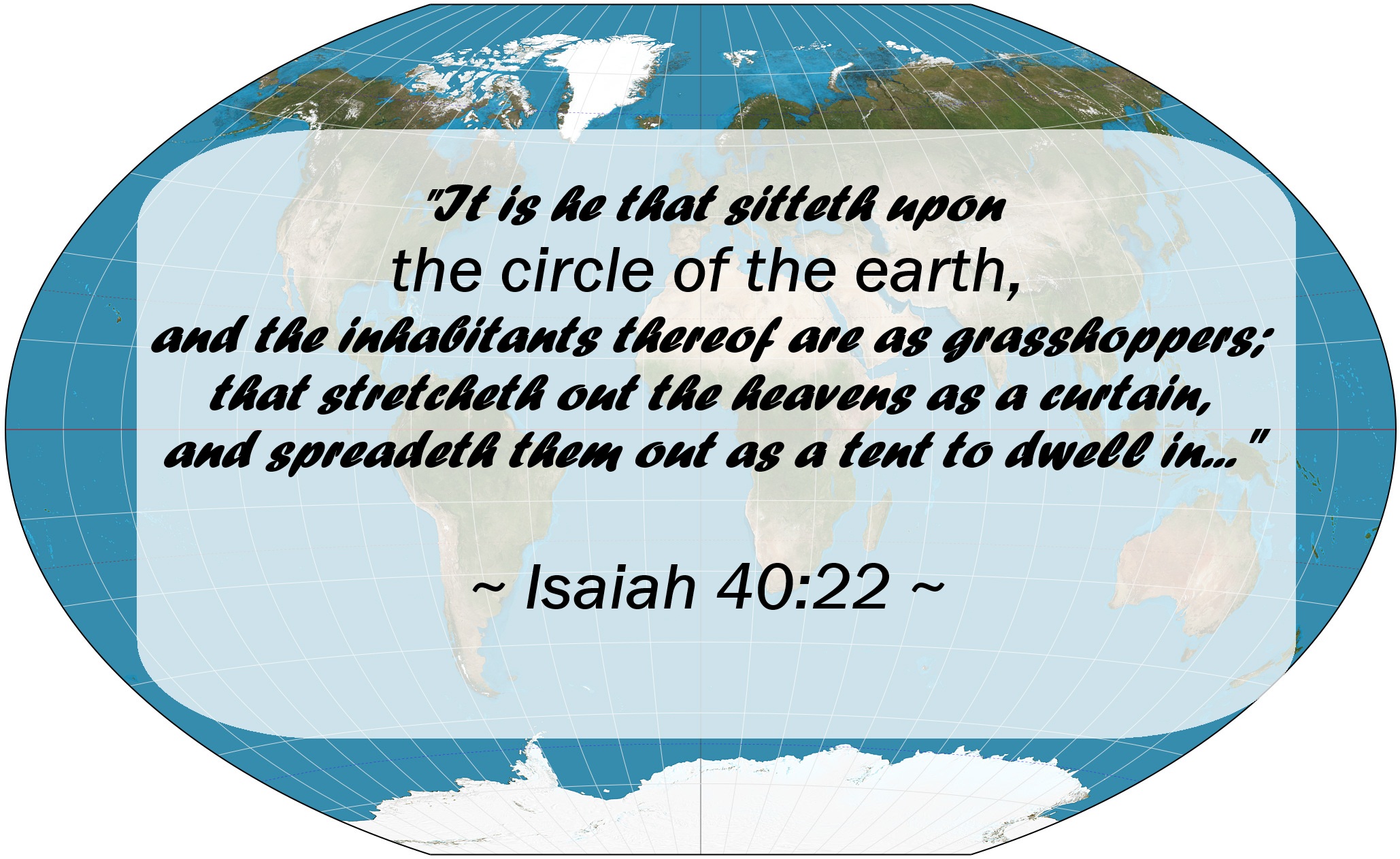
This article will delve into the debate surrounding the concept of a flat earth. The discussion will center on the meaning of the phrase “the circle of the earth” found in Isaiah 40:22. We will consider how this passage has been understood by those who support the flat-earth view, as well as those who argue for a spherical interpretation of the earth. Through careful analysis, we will explore the linguistic, theological, and contextual factors that contribute to differing perspectives, seeking to uncover the most faithful understanding of the biblical text.
Isaiah 40:22 states:
“It is he that sitteth upon the circle of the earth, and the inhabitants thereof are as grasshoppers; that stretcheth out the heavens as a curtain, and spreadeth them out as a tent to dwell in.”
The term “circle of the earth” has led to differing interpretations:
Flat Earth Interpretation
Proponents of the flat-earth view argue that the term “circle” (Hebrew: chûg) describes a flat, circular shape, much like a disc. In this view, the earth is not a sphere but a flat plane with a circular boundary, as seen from above.
Supporters of this interpretation also point to the phrase “spreadeth them out as a tent to dwell in,” suggesting a structure similar to a tent or dome, which fits well with the flat-earth model. In ancient Near Eastern cosmology, the world was often depicted as a flat disk covered by a firmament, like a tent stretched out over the earth.
Additionally, they argue that if the Holy Spirit, inspiring Isaiah, intended to convey the concept of a spherical earth, a different word or phrasing would have been used to avoid confusion.
Spherical Earth Interpretation
Critics of the flat-earth interpretation note that the Hebrew word chûg can mean roundness or circularity in a broader sense, not limited to a two-dimensional plane. In this sense, it could refer to the spherical nature of the earth.
They also highlight that Isaiah is using poetic language to describe God’s sovereignty over creation. The focus is not on providing a scientific description of the earth’s shape but on illustrating God’s transcendence and authority. The comparison to grasshoppers emphasizes the vastness of God’s perspective rather than giving a detailed cosmological model.
Moreover, the phrase “stretcheth out the heavens” can be seen metaphorically, describing God’s creative power rather than suggesting a literal dome or firmament. This interpretation aligns with the broader biblical theme of God’s omnipotence.
Conclusion
The interpretation of biblical texts must consider the intent of the authors, the genre of the passages, and the broader context of Scripture. While the flat-earth interpretation finds some support in the poetic language of certain verses, it is not the only nor the most compelling understanding.
- Focus on God’s Sovereignty: Many passages cited by flat-earth proponents are poetic and emphasize God’s transcendence over His creation. Isaiah 40:22, for example, highlights God’s authority rather than making a definitive statement about the earth’s shape.
- Ambiguity of the Language: The Hebrew word chûg (circle) is ambiguous and can refer to roundness in various dimensions. The Bible does not explicitly state the earth’s shape, allowing for interpretations that are consistent with a spherical model.
- Scriptural Harmony: A faithful approach to interpreting biblical texts seeks harmony within Scripture. The Bible’s emphasis is on God’s relationship with His creation, His power, and His wisdom, rather than providing a scientific textbook.
In conclusion, while the flat-earth interpretation can be argued based on certain passages, the overall weight of Scripture does not necessitate this view. The use of poetic and metaphorical language suggests that the Bible’s primary purpose is not to describe the physical shape of the earth but to reveal God’s majesty and dominion over all creation. Thus, a spherical interpretation of the earth is not inconsistent with a faithful reading of the Bible.